
“Before, I had a cow-calf system, and I distributed grass silage using the tractor grab and wrapped forage in feed racks, explains Nicolas Dubos, a farmer raising 90 Limousines in Couvains in Manche. I had trouble getting them to eat hay. I had to give it to them first thing in the morning, then come back to distribute the rest of the ration. It was time-consuming.”
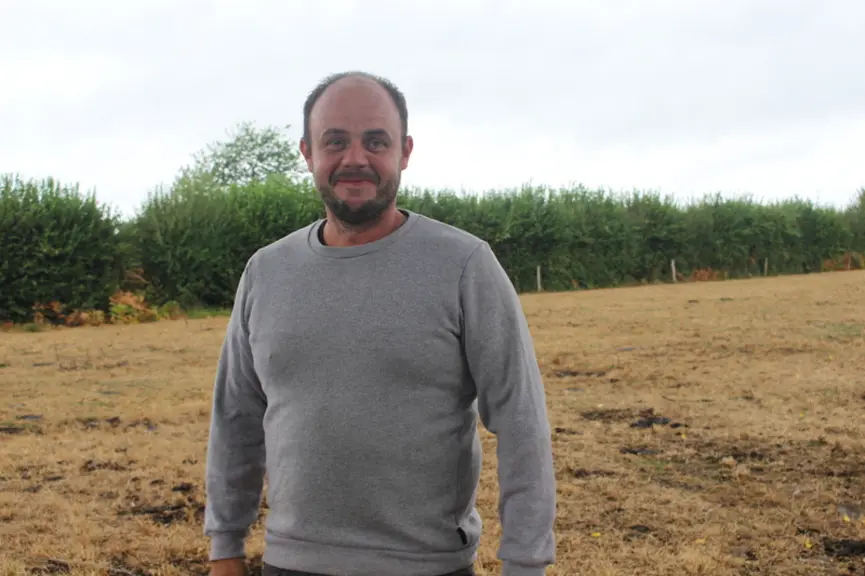
Nicolas Dubos, a Limousin cattle farmer in Manche, bought a reconditioned used mixer feeder.
He changed the type of ration when he started fattening his young cattle and therefore had substantial rations to distribute throughout the year, and when he diversified his grassland forage crops to spread the risks associated with the climate. “I still have a lot of natural grassland, but also some alfalfa, red clover and fescue-based mixtures that are combined with corn silage.”
Read also: “Customized rations with the mixer bucket”
Nicolas Dubos chose a straw mixer bowl second-hand reconditioned, 14 m3. “I wanted a twin-screw system to save time preparing mixed rations. Since the tub is also a straw spreader, there is only one tractor—at 20 000 hours—that always stays attached to it.”
Hay and bale wrapping are processed using the rotocut to save even more mixing time.
Refurbished used double-auger bedding spreader tub
For the livestock farmer, with the complete mixed ration, competition between dominant and subordinate animals is eliminated. “They all eat the same ration at the same time. This is all the more crucial for me because, for now, I am only in place in the building during the winter.” It pushes the ration to noon and evening: there is always something in the feed trough. It observes refusals and the appearance of the droppings to check that digestion is stable.
The bale wrapperhas thus enabled him to make better use of his forage. This equipment also offers other advantages in his view.“There is less waste: all types of hay are consumed at close to 100%, and I can no longer find alfalfa stems in the troughs. And the work is less strenuous.”
Based on the results offorage analysis, the rations are fine-tuned with Littoral normand. In winter, two rations are prepared: one for cows with calves at foot and heifers up to 18 months old, and one for the fattening groups. Supplementation is provided in the form of rapeseed meal and proticorn (a maize bioethanol by-product with 28% crude protein and 12% fat).
Read also:Compact feed to prevent young cattle from sorting through their ration
Livestock farming sheet
110 ha of UAA including 88 ha of natural grassland, 6 ha of alfalfa, 2 ha of red clover, 2 ha of a grassland mixture based on fescue, 6 ha of silage maize and 6 ha of cereals
90 Limousin cattle in a double-calving period, with the sale of young cattle and cull cows
1 UMO