
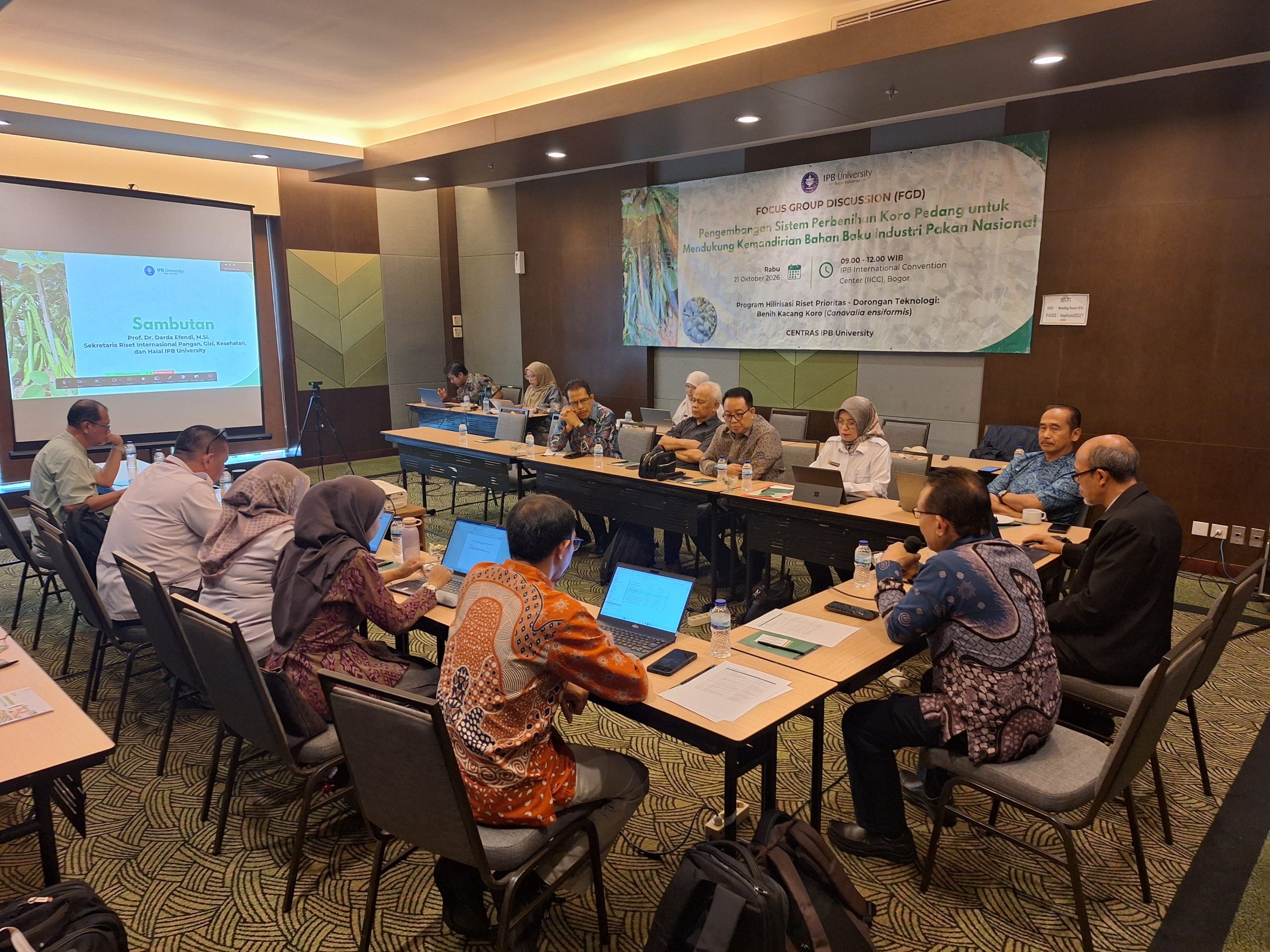
Bogor (TROBOSLIVESTOCK.COM). Priority Research Downstreaming Program – Technology Push: Sword Bean Seeds (Canavalia ensiformis) and Center for Tropical Animal Studies/Center for Tropical Animal Studies (CENTRAS) IPB University held a Focus Group Discussion (FGD) on the theme Development of a Jack Bean Seed System to Support Self-Sufficiency in Raw Materials for the National Feed Industryat IPB Convention Center (ICC) Bogor, West Java, on (21/). This event was held in a hybrid format and attended by academics, activists, sword bean seed producers, and relevant stakeholders.
Speakers namely Dr. Ir. Muchdar Soedarjo, M.Sc. – BRIN Senior Researcher, .Dr. Ir. M. Rahmad Suhartanto, M.Si. – Lecturer and Researcher at IPB, Dr. Tri Melasari, S.Pt. M.Si. – Director of Feed, Directorate General of Livestock and Animal Health (PKH), Ministry of Agriculture of the Republic of Indonesia, Ir. Tevi Melviana, M.Pt, IPU, ASEAN Eng – Chairperson of the Indonesian Animal Feed Producers Association (GPMT), Eko Priyanto, S.Hut. – Director of PT Citra Putra Kebun Asri (PT CPKA), Ir. Dadang Syamsul Munir, M.M. – Director of PT Botani Seed Indonesia (PT BSI) andDrh. Suparmi, M.S. – Head of the South Kalimantan Provincial Plantation and Livestock Office.
Prof. Dr. Ir. Darda Efendi, M. Si - Secretary of the International Research Institute for Food, Nutrition, Health and Halal, IPB Universitysaid in his remarksthat kJack bean can be used as animal feed as well as an alternative food ingredient to replace soybeans. However, several problems remain, particularly in the provision of seeds. “At present, jack bean cultivation has not yet been developed on a large scale. If it is later developed commercially on a large scale, challenges will certainly arise regarding the availability of sufficient quantities of seeds,” he explained.availability of sufficient quantities,” he explained.
Therefore, he expressed hope that the material presented by the speakers and the various matters discussed together could give rise to new ideas and be followed up through studies and concrete action in the field. “Thus, the results of this activity will not stop at discussions in this room but can also be implemented to increase seed production capacity, post-harvest handling, seed storage, and distributioninterregional sword bean seeds,” he explained.
Sword BeanProtein Source
Muchdar Soedarjo, Researchers from BRIN explain that jack bean is a potential agribusiness crop. Production of jack bean seeds is about 4 ton/ha (160 g/plant) with a population of 25 thousand plants (plant spacing 80 x 50 cm). On 2019 sword bean seed prices are Rp 8000 to Rp 10 000 per kg, so the selling value per Ha is Rp 32 – 40 million in 5-6 months with, far exceeding the sales value of soybeans or other legume crops.
Contains a relatively high amount of protein (28.6 %) and low fat content (2.26 %) and can be used as one of the raw materials for manufacturing products such as tempeh, tofu, yogurt, milk, chips, biscuits, and abon. Then it is a pfunctional benefits because it contains high levels of antioxidants: anti-hypertensive, anti-diabetic 2. “Sword bean seeds are also an export commodity. Sword bean plants can be cultivated in areas that are relatively infertile and have limited water, while dLess fertile and water-scarce areas are widespread in Indonesia,” he said.
Tri Melasari, Director of Feed at the Directorate General of Livestock and Animal Health (Ditjen PKH), Ministry of Agriculture, stated rRevenue realization Bahan Pwill Asal Tumbuhan (BPAT) in 2026 reached 7,79 million tons, up 1,3% compared with the realization in 2025 amounting to 7,70 million tons. SBM continues to dominate, with a share of approximately 68,7 % of the total realization 2026 which indicates the high demand for imported plant-based protein. The availability and stability of BPAT supplies, especially SBM, are important for maintaining smooth production and controlling feed costs.
Sstructure Production costs for livestock farming in Indonesia at the company level are dominated by feed, the largest cost component. Feed costs reach 67,82 % in broiler chickens (broiler)and 74,66 % in laying hens (layer). Meanwhile, at the household level, feed costs reach 56,96 % in broiler and 71,71% on layer.
Meanwhile pNational feed production increased from 17,64 million tons in 2022 to 20,35 million tons in 2025. The increase was primarily driven by poultry feed, which reached 19,64 million tons in 2025, or approximately 96,52 % of total production. “At 2026, feed production was recorded at 16,72 million tons, with poultry feed amounting to 16,11 million tons, or approximately 96,35 %,” he emphasized.
One of the policy directions is to increase the use of local feed ingredients, including
dDiversifying national feed ingredients. By developing jack beans as an alternative local source of plant protein to reduce dependence on certain ingredients, expand feed formulation options, and strengthen the resilience of feed industry ingredient supplies.
Then, ensuring the safety and quality of feed ingredients. Strengthening domestic production and supply, developing processing technologies, developing the industry and market, and the need for regulatory support, research, and guidance. “Sufficient, affordable feed raw material availability that meets quality standards is one of the important factors supporting the sustainability of the national livestock business,”he added.
Tevi Melviana, General Chairperson of the Indonesian Feedmills Association (GPMT), said bLocal raw materials have great potential to gradually reduce Indonesia’s dependence on imported raw materials, especially protein sources for the animal feed industry. So far, GPMT members still heavily dependent on imports of various protein source raw materials, such as Soy Bean Meal (SBM), Meat And Bone Meal (MBM), and other protein raw materials.
“PThe proportion of imported protein raw materials is estimated at around 30– 35 %, its economic value can reach 60 – 65 % of the total feed production costs,” he explained. Therefore, if this local protein source development project can be realized and produce products that meet industry needs, it will bring significant benefits to Indonesia. In addition to reducing dependence on imports and saving foreign exchange, this development will also increase the use of local raw materials and strengthen the independence of the national feed industry.
Protein sources are a very important component in feed formulation because they provide the essential amino acids needed for growth and muscle tissue formation, both in poultry (poultry)or ruminant livestock. Thus, developing local protein sources is not only a business opportunity but also a strategic step toward strengthening the resilience of the feed industry, increasing the added value of domestic resources, and supporting the sustainability of Indonesia’s livestock sector. ramdan