
Falling hog prices weighed on the hog-raising business, and Wen's Foodstuff Group Co., Ltd. posted a loss of 49.61 billion yuan in the first three quarters.
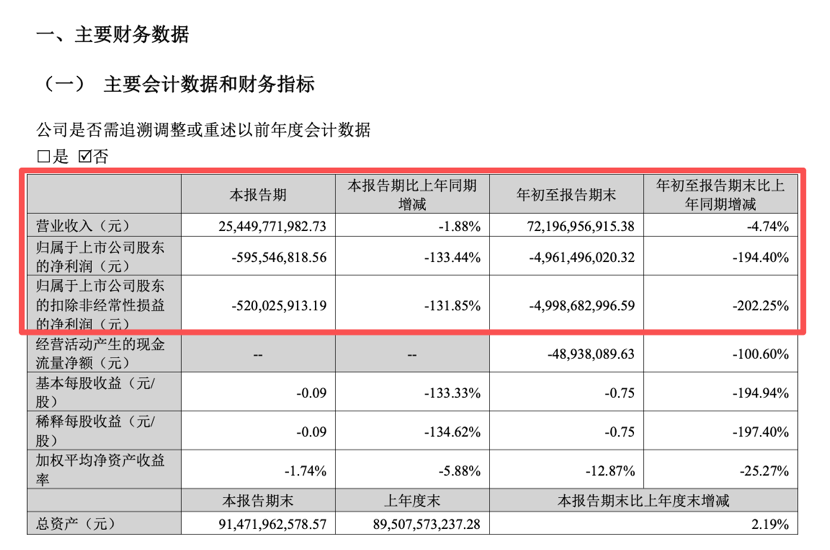
Wen's Foodstuff Group Co., Ltd. (300498) disclosed its third-quarter report for 2026 on 10 21: revenue for the first three quarters was 721.97 billion yuan, down 4.74% year on year; net profit attributable to shareholders of the listed company was a loss of 49.61 billion yuan. In the third quarter, revenue was 254.50 billion yuan, down 1.88% year on year; net profit attributable to the parent company was a loss of 5.96 billion yuan. The company said the change in performance was mainly due to a sharp decline in the price of its main product, livehogprices, resulting in substantial losses in its hog-raising business.
In terms of sales data, company announcements show that from 7 to 9, Wen's Foodstuff Group's live-hog sales volume and revenue rose month by month, but prices faced clear year-on-year pressure. Live-hog sales volume increased from 274.21 ten thousand head to 298.83 ten thousand head, while revenue rose from 36.62 billion yuan to 40.56 billion yuan. The average selling price of live hogs was 10.80 yuan per kilogram in 7, edged up to 10.86 yuan per kilogram in 8, then fell to 10.75 yuan per kilogram in 9, down 18.44% year on year. The drag on performance from prices continued.
Wen's Foodstuff Group's broiler business, by contrast, recovered month by month. Broiler sales volume increased from 11259.24 ten thousand birds to 12595.71 ten thousand birds, and revenue rose from 27.21 billion yuan to 37.31 billion yuan. The company's average selling price for live broilers rose from 11.49 yuan per kilogram to 14.20 yuan per kilogram, up 4.95% year on year in 9.
At the investor exchange event held in 9 month, Wens Foodstuff Group stated that pig prices have remained low for a relatively long time. There are differing views in the industry and the market regarding the specific timing and extent of a cyclical reversal. It is preliminarily expected that pig prices may reach a consolidation turning point around the Spring Festival. The company said that the industry generally expects a high degree of certainty that it will achieve profitability in 2027 year. Profitability will depend on pig price trends in the third and fourth quarters of this year and on the industry's capacity reduction. Historical experience shows that the longer pig prices remain low, the more fully capacity is reduced, and the greater the momentum accumulated for a subsequent price recovery. If the industry as a whole still fails to achieve profitability next year, large-scale capacity exits will occur, and pig prices may subsequently enter a phase of rapid increases.
Regarding the reasons for the relatively slow capacity reduction during this pig price downturn cycle, the company said: First, industry concentration has continued to increase in recent years, and leading companies have relatively diverse financing channels and significantly greater resilience to cyclical downturns than in the past, when the industry was dominated by small-scale farmers. Second, companies that were profitable in the earlier period still have substantial financial reserves. Third, some market participants are taking chances, hoping that others will exit first while they themselves increase production against the trend. Together, these factors have prolonged the current loss-making cycle. As losses continue, financial pressure is gradually becoming apparent for some industry participants, and capacity reduction is expected to accelerate.
Wen's Foodstuff Group Co., Ltd. (300498) disclosed its third-quarter report for 2026 on 10 21: revenue for the first three quarters was 721.97 billion yuan, down 4.74% year on year; net profit attributable to shareholders of the listed company was a loss of 49.61 billion yuan. In the third quarter, revenue was 254.50 billion yuan, down 1.88% year on year; net profit attributable to the parent company was a loss of 5.96 billion yuan. The company said the change in performance was mainly due to a sharp decline in the price of its main product, livehogprices, resulting in substantial losses in its hog-raising business.
In terms of sales data, company announcements show that from 7 to 9, Wen's Foodstuff Group's live-hog sales volume and revenue rose month by month, but prices faced clear year-on-year pressure. Live-hog sales volume increased from 274.21 ten thousand head to 298.83 ten thousand head, while revenue rose from 36.62 billion yuan to 40.56 billion yuan. The average selling price of live hogs was 10.80 yuan per kilogram in 7, edged up to 10.86 yuan per kilogram in 8, then fell to 10.75 yuan per kilogram in 9, down 18.44% year on year. The drag on performance from prices continued.
Wen's Foodstuff Group's broiler business, by contrast, recovered month by month. Broiler sales volume increased from 11259.24 ten thousand birds to 12595.71 ten thousand birds, and revenue rose from 27.21 billion yuan to 37.31 billion yuan. The company's average selling price for live broilers rose from 11.49 yuan per kilogram to 14.20 yuan per kilogram, up 4.95% year on year in 9.
At the investor exchange event held in 9 month, Wens Foodstuff Group stated that pig prices have remained low for a relatively long time. There are differing views in the industry and the market regarding the specific timing and extent of a cyclical reversal. It is preliminarily expected that pig prices may reach a consolidation turning point around the Spring Festival. The company said that the industry generally expects a high degree of certainty that it will achieve profitability in 2027 year. Profitability will depend on pig price trends in the third and fourth quarters of this year and on the industry's capacity reduction. Historical experience shows that the longer pig prices remain low, the more fully capacity is reduced, and the greater the momentum accumulated for a subsequent price recovery. If the industry as a whole still fails to achieve profitability next year, large-scale capacity exits will occur, and pig prices may subsequently enter a phase of rapid increases.
Regarding the reasons for the relatively slow capacity reduction during this pig price downturn cycle, the company said: First, industry concentration has continued to increase in recent years, and leading companies have relatively diverse financing channels and significantly greater resilience to cyclical downturns than in the past, when the industry was dominated by small-scale farmers. Second, companies that were profitable in the earlier period still have substantial financial reserves. Third, some market participants are taking chances, hoping that others will exit first while they themselves increase production against the trend. Together, these factors have prolonged the current loss-making cycle. As losses continue, financial pressure is gradually becoming apparent for some industry participants, and capacity reduction is expected to accelerate.