
A relentless decline! Hog prices have “fallen sharply”; the logic behind the decline has been found! Gearing up for a rebound?
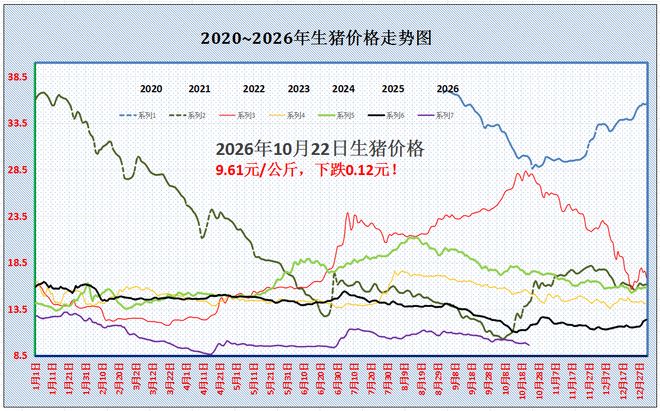
Time flies, and the traditional “Golden September and Silver October” period is nearing its end. Recently, hog prices in China’s domestic live hog market have followed a “steady” downward trend! In particular, during “Golden September and Silver October,” hog prices have “fallen relentlessly,” with the price center repeatedly breaking lower. At the beginning of 9, quotes for standard hogs stood at 11.09 yuan/kg. However, by late 10, the price center had retreated to 9.61 yuan/kg. The market has seen an “overly rational” decline, highlighting a peak season that has failed to deliver! In particular, after National Day, hog prices continued to fall on momentum, with prices persistently searching for a bottom!
As of 10 22, the national average ex-farm price for lean-meat-type standard hogs was 9.61 yuan/kg, down 0.12 yuan from yesterday. The decline in hog prices widened, and the average price for standard hogs retreated to around 4.8 yuan/jin, with the decrease from the same period last year widening to 16.72%. Hog finishing is deeply unprofitable; losses from self-breeding and self-raising at some leading hog companies may exceed 260 yuan/head, while losses at smallholder farms may exceed 500 yuan/head. The market is showing a pattern of “prices falling easily and rising with difficulty”!
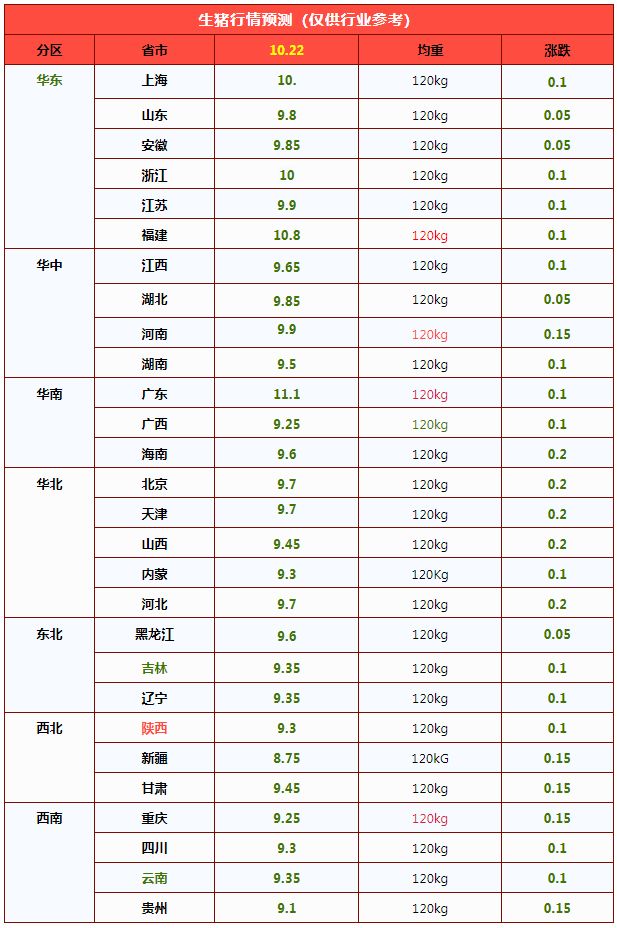
In particular, feedback from across the country indicates that, among the 7 key production regions monitored across the north and south and the 28 provinces and cities that can be monitored, domestic live hog quotes are “in the red” across the board. Mainstream quotes are down 0.05-0.2 yuan/kg, and the average live hog price has fallen to a level close to that in Heilongjiang. Across the north and south, mainstream live hog quotes have retreated to around 9.2-10.1 yuan/kg. The price center for hogs has “broken lower.” In particular, in East China, live hog quotes have generally fallen to 9.8-10.1 yuan/kg, and the market is seeing a steeper-than-expected decline!
At present, hog prices in China’s domestic live hog market are “falling relentlessly.” Compared with 10.25 yuan/kg at the beginning of the month, hog prices have fallen by a cumulative 0.64 yuan/kg within the month, a decrease of 6.24%. Hog prices have been sliding sharply. In my view, the logic underpinning the decline is as follows:
Cold weather activity has become increasingly frequent recently, causing significant temperature fluctuations across northern and southern China. This has increased stress risks for fattening pigs and the incidence of disease at pig farms. Panic among producers has strengthened, and their willingness to market pigs is relatively high!
Last week, the average weight of standard pigs marketed rose to 124.33 kilograms. Average pig weights increased substantially, and the structure of market inventories changed. In particular, the share of medium and large pigs in inventories gradually increased. Cooler weather is accelerating weight gain during pig fattening, increasing the supply of standard pigs at market weight. With supply remaining ample, the price spread between fat and standard pigs has gradually narrowed in many areas, reducing the cost-effectiveness of holding pigs for additional weight and increasing producers’ willingness to market them. In particular, pig fattening has been loss-making for an extended period, leaving pig farms with significant financial difficulties and increasing the need for involuntary sales to generate cash!
On the supply fundamentals, sow inventories began to recover from their decline at the end of last year and remain at a high base. Meanwhile, PSY has risen substantially, greatly improving the number of piglets provided per sow and further intensifying the pressure from latent production capacity in market-ready pigs in the current period. In combination with insufficient marginal support from demand last month, group pig enterprises’ marketing plans were not completed well. With production at many pig enterprises lagging behind, the supply of market-ready commercial pigs is set to increase further this month, and production capacity is still being released through its existing momentum!
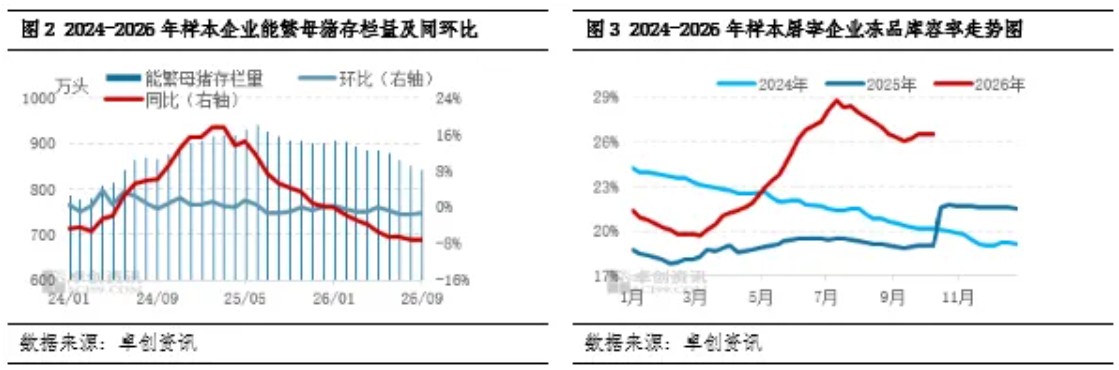
Based on recent consumer-market feedback, demand for pork purchases and sales has been subdued. Although cooler weather has improved expectations for pork demand, market feedback has been lackluster! In particular, changes in residents’ consumption habits have gradually reduced pork’s share of demand. Downstream sales of white carcasses have been poor, orders at slaughterhouses have contracted, and operating rates have hovered around 30.31%. Demand lacks any clear support! In addition, last week the frozen pork inventory ratio at sampled slaughterhouses was 31.87%. Frozen pork inventories remain high, further dampening market confidence in price increases. Slaughterhouses are mostly producing to order and have insufficient demand for market-sourced pigs!
Based on this analysis, under the push and pull between supply and demand, pig prices are under pressure and falling, with the center of gravity continuing to decline. As market sentiment remains strongly bearish, the market may continue to weaken for a short time! Although some institutions remain confident that prices will rise later, in theory, pig prices may be unlikely to see any substantial improvement! Focus on changes in the pace of live hog purchases and sales at the grassroots level!
All in the red! Pig prices fall “sharply”; will they break below the “previous low” at the end of 10?
Entering the second half of 10, the domestic live hog market has recently seen the official release of third-quarter sow inventory data: the national inventory of breeding sows fell 10.7% year on year to 3602 ten thousand head, already below the official regulatory threshold! However, sow inventories affect the supply of market hogs 10 months later. Market confidence in next year's pig price outlook has recovered, but the live hog market still faces the fundamental issue of “excess supply” in the short term. In addition, the market lacks confidence in the pig price outlook for the fourth quarter, and pig prices are falling “sharply.” So, with pig prices continuing to decline, will they break below the “previous low” at the end of 10? Details are analyzed below:
According to the latest information, as of 10 month 22, the national average ex-farm price for lean-type three-way crossbred commercial hogs was 9.61 yuan/kg, down 0.12 yuan, with the decline widening significantly. Prices fell across northern and southern markets, “all in the red,” and were down more than 16.7% year on year. Losses in hog production deepened, and the market saw an “overly rational” decline!
In particular, all 28 regions monitored in key markets across northern and southern China saw prices fall. The average live hog price was close to the 9.6 yuan/kg reported in Heilongjiang and Hainan. Hog prices across the north and south ranged from 8.75-11.1 yuan/kg, with Xinjiang the lowest and Guangdong the highest! In traditional production and consumption markets, live hog prices in the Northeast have now fallen to 9.35-9.6 yuan/kg. In southern markets, prices in Sichuan and Chongqing fell to 9.25-9.3 yuan, those in Shandong and Anhui were 9.8-9.85 yuan, and those in Jiangsu and Zhejiang fell to 9.9-10 yuan/kg...
Currently, hog prices in markets across the north and south of China have generally fallen below 10 yuan/kg. In some regions, the average price for hogs shipped out has fallen back to around 9 yuan/kg. The market is on a broad downward trend. The following analysis explains the factors supporting the decline in hog prices:
Reports indicate that although the national breeding sow inventory gradually declined last year, falling to 3961 ten thousand head by year-end, in theory, hog shipments should gradually decrease during this year's “Golden September and Silver October” months. However, actual reports show that hog shipment plans increased slightly in 9 month, and sample hog companies achieved 99.01% of their shipment plans. With the lagged effects of production capacity, the overlapping supply trend became pronounced in 10 month! This month, the shipment plans of 173 large-scale hog companies totaled 1508.18 ten thousand head, up 1.91% month on month. The hog market's “hidden production capacity” remains in a phase of concentrated release. In particular, although the breeding sow inventory has declined, improved production efficiency has further intensified oversupply pressure!
As temperatures fall in northern and southern regions, hogs are gaining weight more quickly during finishing, and average shipment weights continue to rise, further strengthening market supply capacity!
However, unlike supply, which is being released at a high level, marginal demand support remains weak. After the National Day holiday, consumption typically declines. Although cooler weather benefits household demand, consumers generally have alternatives, and poultry, aquatic products, and eggs are inexpensive. Residents show limited willingness to buy pork, slaughterhouse orders have not increased, and operating rates remain low, leaving slaughterhouses somewhat unable to absorb the available hog supply!
As a result, amid changes in supply and demand, the market has recently shown a downward trend. At present, bearish and stable price expectations are both strong in the hog market. In theory, over the next 1-3 days, hog prices may continue to seek a bottom, potentially falling below 9.5 yuan/kg. However, I believe hog prices are unlikely to fall below the “previous low”; there is little chance of prices reaching 8.63 yuan/kg in mid-4, and the market still has bottom support. Going forward, attention should be paid to changes in sales by major hog-producing companies and sentiment around secondary fattening, especially as the weather turns cooler and seasonal demand changes.
White-Striped Pork: After a weak, bottoming trend in the first three quarters, can prices recover in the fourth quarter?
In the first three quarters of 2026, domestic white-striped pork prices followed a weak, bottoming trend. The price level was significantly below that of the same period in 2024 and 2025, and the range of price adjustments during the year also narrowed. Looking ahead to the fourth quarter, temperatures will fall and the curing season will gradually begin, supporting a recovery in end-user demand. However, the broad supply-side picture is unlikely to change, so domestic white-striped pork prices may only rebound from low levels, with the quarterly average still declining quarter on quarter.
1. White-Striped Pork Prices Continued to Bottom Out in the First Three Quarters of 2026, with the Price Spread Narrowing During the Year
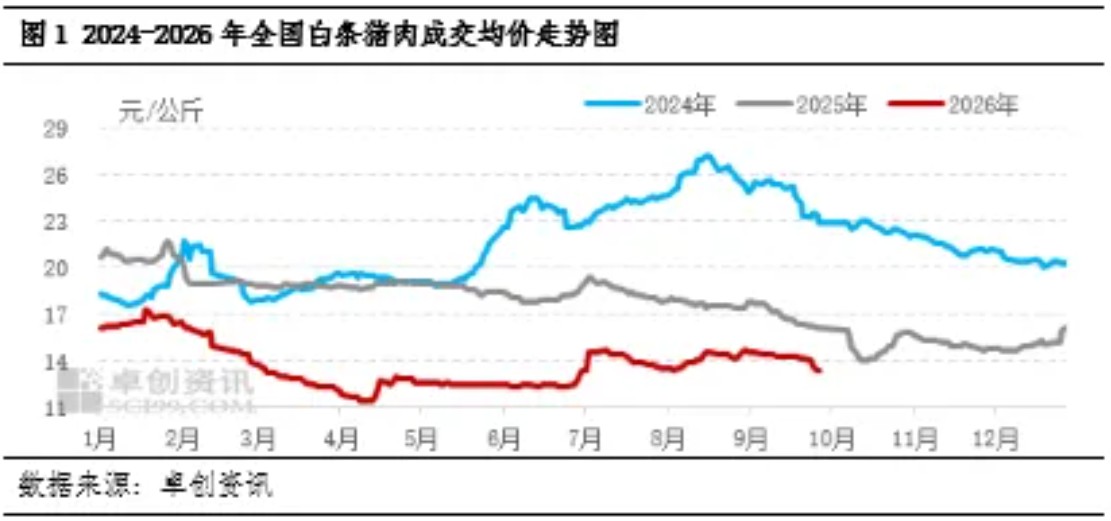
As shown in Figure 1, domestic white-striped pork prices in the first three quarters of 2026 first fell and then edged up amid fluctuations. Overall, they remained at a multi-year historical low, with the price level on the low side. According to Zhuochuang Information, in the first three quarters of 2026, the average transaction price of white-striped pork with a backfat thickness of 2.5-3.5 CM was 13.82 yuan/kg, down 25.62% from the same period in 2025 and down 36.25% from the same period in 2024. The year's high was 17.24 yuan/kg on 1/19, and the low was 11.38 yuan/kg on 4/13. The year's maximum price spread was 5.86 yuan/kg, narrowing by 24.19% compared with the maximum spread in 2025, and by 38.96% compared with the maximum spread in 2024.
2. Ample supply and weaker-than-expected demand kept the market generally weak in the first three quarters of 2026
The main reasons domestic dressed pork prices remained low in the first three quarters of 2026 were the supply glut caused by the concentrated release of upstream production capacity and demand weakening year by year. On the supply side, as shown in Figure 2, the upstream breeding sow herd continued to expand from 2024 through the first half of 2025; although the breeding sow inventory gradually declined in the second half of 2025, the decrease was limited, and levels remained relatively high overall. Based on the growth cycle of live pigs, 2026 was a period of concentrated release of pig production capacity, with an ample supply of pigs at suitable slaughter weights, enabling slaughtering enterprises to procure smoothly. Although slaughtering enterprises also built up inventories when prices were low, frozen products accounted for less than 10% of total pork output. The supply of dressed pork still increased significantly during the year, leaving the market oversupplied overall.
On the demand side, in recent years, the actual demand for pork has been weaker than expected due to a range of factors, including changes in residents’ dietary patterns, shifts in the main consumer groups, and low prices for substitute products. At the same time, high inventories of domestically produced and imported frozen products, with low-priced frozen products putting some pressure on the fresh-product market, together with the gradually weakening boost from peak-season demand, contributed to pork consumption falling short of expectations during the year. Dressed pork generally moved more slowly.
3. In the fourth quarter of 2026, abundant supply may cause the average price to decline quarter on quarter
Domestic prices of white-cut pork are expected to decline quarter on quarter in the fourth quarter of 2026. On the supply side, based on the growth cycle of live pigs, the number of domestic pigs at market weight in the fourth quarter of 2026 is estimated to decrease by approximately 1.4% quarter on quarter. However, with the peak season for larger pigs approaching, producers are inclined to hold pigs back and increase their weight. The average post-slaughter weight in the fourth quarter may rise by 1%-2%. Meanwhile, frozen-product inventories at slaughtering enterprises are currently high, and most are strictly controlling the proportion allocated to cutting. The fresh-product sales rate may increase slightly by 2-4 percentage points. Overall, white-cut pork supply is expected to increase in the fourth quarter. On the demand side, pork consumption is seasonal: as temperatures fall, demand for fresh products is expected to improve, boosted by the custom of “fattening up for autumn” and by the curing of meat and making of sausages. However, channels such as prepared-food processing and catering stocked up early in the second quarter. Fourth-quarter demand for frozen products is below expectations, while there is a relatively high likelihood that inventories held by companies and ports will be released onto the market in concentrated volumes, with low-priced frozen products putting some pressure on fresh pork sales. Overall, pork demand is expected to improve in the fourth quarter, but the improvement may fall short of expectations.
Overall, both pork supply and demand are increasing, but the increase in supply is greater than that in demand. According to SunSirs, white-cut pork prices are expected to decline quarter on quarter in the fourth quarter of 2026. By month, white-cut pork prices are expected to edge down gradually in 10 of 2026, with the monthly average price declining by 7%-9% quarter on quarter. In 11, prices may rebound from a low level, supported by demand, with the monthly average price rising by 5%-8%; the peak is unlikely to break the “fifteen yuan” mark. In 12, the improvement in demand is expected to weaken, while pigs are released onto the market in concentrated volumes. Prices may edge down again, and the quarter-on-quarter decline in the monthly average price of white-cut pork is expected to be within 3%.