“The heating at the silo face is a real concern: the forage deteriorates, loses feed value, and intake decreases. Yet few farmers manage to advance by 15 cm per day,” says Jérôme Larcelet, nutrition consultant at Virtuoz.
To check whether the siloWhen it heats up, he advises taking the temperature of the silo at the face; it should be + or – 5°C relative to the outside temperature; but also deeper inside, between 80 cm and one meter; it should be about 15°C all year round. “If the forage heats up, there are remedial solutions involving combinations of acid salts to add to the ration to preserve it, but these measures are also useful for planning the following season and preventing the situation from happening again,”, explains the consultant.
It is better to avoid directing theattack facesdue south. “If possible, also avoid having silos open in heavy rain,says Stéphane Lauzet, an independent livestock farming adviser. Some cover the attack face, for example with a sliding gate or a barrier covered withsilage wrap.”
Read also: Assessing forage quality begins at harvest
“The silo size must also be adapted to the herd’s daily needs, to maintain a feed-out rate of about 15 cm per day, preferably 10 in winter and 20 in summer, explains Julie Peyrat, an independent livestock farming advisor. We calculate the herd’s daily requirement in kg, divide it by the target density (220 kg DM/m3) to get a daily volume in m3. We then divide this figure by the feed-out rate in meters to get an area in m².”
More fermentable starch
“However, be careful when using a coring tool to assess the actual density of a silage silo, we realize that the density is closer to 200 than to 220. And that changes the amount of stock”, Eva Garre explains.
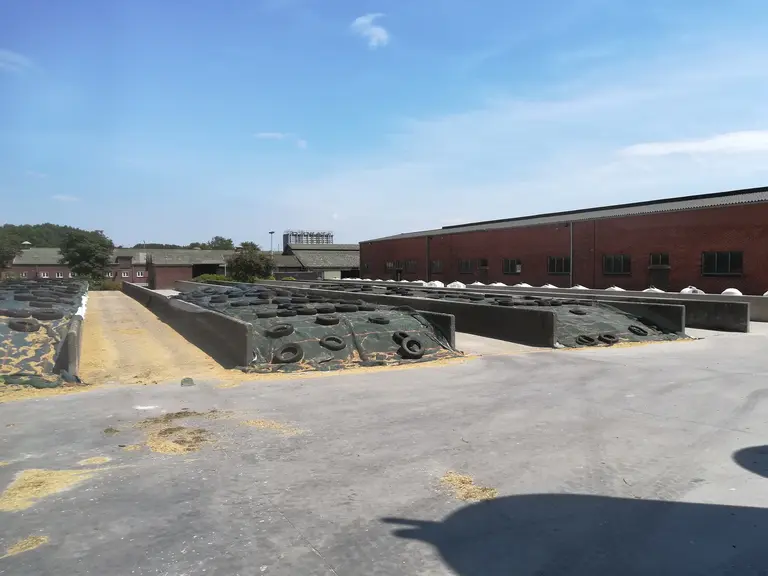
According to the advisers, it is better to design small, narrow but long silos, in order to move forward as quickly as possible. “Small silos are less easy to compact, concedes Jérôme Larcelet, but then we avoid the daily losses from large silos that heat up.”
Read also: Cattle feed: “Our Salers cows have access to a self-service grass silage bunker”
In addition, “in corn silage the further along we get, the more fermentable the starch becomes. After six months, we have gained 200 to 300 g of fermentable starch, explains Julie Peyrat.Thus, keeping a small closed silo can be worthwhile, for fatteningyoung cattlewith less concentrate, for example.”For grass, however, “a grass silo should not be kept for more than 10 to 12 months, because the proteins eventually break down,”the adviser says.