Key points:
-
An global soybean harvest abundant
-
Plentiful palm oil in Malaysia
-
A strong canola harvest in Canada is being confirmed
The oilseed market remains dominated by the abundance of supply global. The harvests record soybeans in the United States, the strong canola production in Canada and the stocks of exceptional palm oil in Malaysia continue to exert downward pressure on the prices. However, support from biofuels and low levels of soybean oil stocks limit the downside potential for vegetable oils, which show better resistance than the seeds and the oilcakes.
Soybean prices fall again on the CBOT
The soybean prices on the CBOT fell again this Tuesday. They were down 1 to more than 5 cents$/bushel, depending on the contract month, with losses being greater for nearer contract months. The United States raised their harvest estimate to 124,15 Mt, or approximately 8 Mt more than last year, while weather conditions remain generally favorable in the United States and Brazil.
While the global soybean market has recently remained under pressure due to abundant harvests in the United States and favorable prospects in Brazil, the situation in India provides a more constructive factor for prices.
The kharif soybean 2026 harvest in India is now estimated at 10,79 Mt, against 11,03 Mt last year (-2,1 %). This decline is attributed to the drought that affected several producing states, notably Maharashtra, Karnataka and Telangana.
For the November 2026 contract, the second most-traded contract, soybeans were down 5,25 cents to 1248,25 cents per bushel. The January 2027 contract was also down 5,25 cents$/bushel at 1263,5 cents per bushel.
The dollar weakened slightly this Tuesday against the euro after tensions eased in several European countries, favoring exports from the United States. The eurowas trading at 1,1238 dollars to 1,1213 dollars on Monday. This morning at 6 hours 367 (Paris time), the euro was trading at 1,1224 dollars.
TheUSDA reported new sales of 612 000 tonnes of U.S. soybeans to China for the 2026-2027 marketing year.
Soybean meal prices are still falling
The soybean meal prices on the Cbot were down by 1 to more than 6 €/t depending on the delivery dates, with the declines being all the greater the nearer the delivery dates, as was the case for soybeans.
For the December 2026 contract, the soybean meal price fell by 6,10 €/t to 348,7 €/t, while for January 2027, the soybean meal price lost 5,40 €/t to 347,5 €/t.
This decline in soybean meal prices over the past several days has been reflected in the price in France. The price of soybean meal delivered to Montoir thus fell by 2 €/t in Montoir to 466 €/t.
Global meal availability is substantial due to soybean crushing driven by demand for oil for biofuels. Crushing margins are currently favorable as well, encouraging crushers to maintain a high pace.
The rapeseed meal nevertheless remains well positioned relative to the soybean meal with a February delivery price, ex Brest or Lorient, of 323 €/t.
Soybean oil prices are little changed in Chicago but remain bullish, while palm oil prices are holding up despite dominant bearish factors.
Soybean oil prices on the Cbot Chicago prices were relatively stable for the nearby contracts of 2026 and 2027, which recorded a very slight gain, and fell by less than 0,5 cents$/pound for the more distant contracts.
For the November 2026 contract, the most actively traded contract, the price of soybean oil gained 0,04 cents$/pound to 66,73 cents$/pound, and for January 2027, the increase was 0,08 cents$/pound to 66,91 cents$/pound.
U.S. soybean oil stocks have fallen to their lowest level since 2014, reflecting sustained demand from the biofuels sector, which could limit the downside potential of oilseed markets.
Crude palm oil prices were rising across all nearby maturities, supported by high energy prices. On the MDEX, the price of crude soybean oil for January 2027, the most actively traded maturity, broke above 4800 ringgits/t to 4817 ringgits/t, compared with 4766 ringgits/t the previous day. For December 2026, the 4700 ringgit/t threshold was also breached, reaching 4732 ringgits/rt, compared with 4666 ringgits/t the previous day.
The strong demand for palm oil driven by the B50 program in Indonesia is pushing domestic demand higher. According to several analysts, several million tonnes of palm oil could be withdrawn from the global market, explaining the rise in prices. However, it should be noted that Indonesia is currently facing logistical difficulties that are limiting immediate availability and preventing a significant drop in prices.
Finally, record-high stock levels in Malaysia confirm that global supply remains abundant despite strong demand from the biofuels sector. The latest data from the Malaysian Palm Oil Board (MPOB) indeed confirm a marked deterioration in the short-term palm oil balance. In September, total palm stocks in Malaysia surged by 24,5% over one month to reach 3,51 Mt, representing an increase of nearly 692 000 t. This is one of the highest levels ever observed in the country. The combination of record production and disappointing exports explains the surge in stocks.
Malaysia is considering temporarily suspending its 10% tax on crude palm oil (CPO) exports to reduce its record-high stocks, estimated at 3,5 million tonnes. This measure would aim primarily to restore the competitiveness of Malaysian palm oil against Indonesia, where prices are currently lower by 700 to 900 RM/t.
If such a decision were made, palm oil prices could fall more or less sharply on the global market, according to several analysts.
Nevertheless, energy prices support the market. The contract The December Brent futures contract remained close to 110 $/t and was declining this Tuesday 0,10 % to 109,07 $/barrel, while the West Texas Intermediate (WTI) November expiryreceded by 5,03 % at 98,31 $/barrel. This Wednesday morning at 6: 54 (Paris time), the prices of the Brent was rising by 1,12% and that of oil WTI of 0,78%.
The global market for sunflower tis currently going through a consolidation phase amid the arrival of new crops in the Black Sea region and South Africa. Harvests are progressing under favorable conditions in Ukraine, Russia and South Africa, supporting an improvement in supply. Increased availability is putting downward pressure on seed prices, while persistent logistical difficulties in Ukraine are limiting the decline in prices of sunflower oil.
The price of sunflower oil is currently moving within a relatively stable range around 1 030-1 040 €/t FOB/CPT Black Sea.
Rapeseed and canola prices fall under pressure from the Canadian harvest
About theICE of Winnipeg, the course of canolafell by 4 to 7 $CAN/t depending on the delivery dates, following its drop the previous day. On January 2027, the most actively traded delivery date, it fell by 6 $CAN/t to 781 $CAN/t, while for November 2026, it also lost 6 $CAN/t to 781 $CAN/t.
Canola harvest is accelerating in Canada. As of 12 October, 89% of the area had been harvested in Saskatchewan, 86 % in Manitoba, and 74 % in Alberta.
Canadian production 2026/27 is now estimated at around 22,1 Mt, thanks to a record area of nearly 23 million acres. This harvest is significantly larger than last year's despite slightly lower yields. Ending stocks have also been revised upward, putting pressure on prices. In addition, canola exports to China rebounded sharply in 2026 after import restrictions were eased, and Canadian exports have already exceeded 2,5 Mt, mainly between January and August 2026.
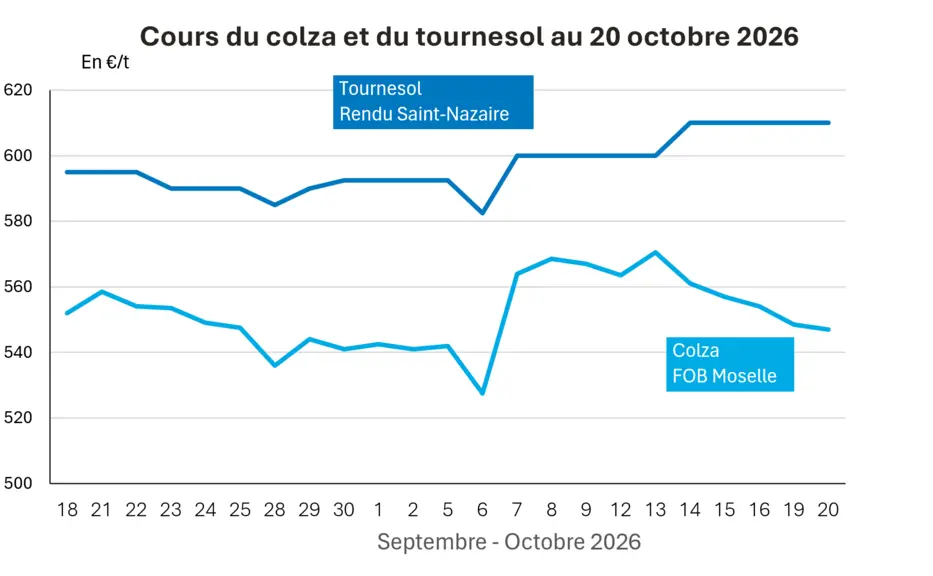
On Euronext, the course of rapeseed fell from less than 1 to more than 3/t depending on the delivery dates. For February 2027, the main delivery date traded during this period of the year fell from 1,50 €/t to 545 €/t. Rapeseed remains under pressure given international competition. The good Canadian production of canola and the decline in its prices limit the upside potential of the rapeseed.
European crushing plants already appear to be well covered in their supply, limiting demand for seeds and the urgency of purchases.
Ukraine adds a bearish factor, with rapeseed stocks still available and flows to Europe remaining active. European Union rapeseed imports as of 18 October amount to 1 088 203 tonnes, compared with 1 766 726 tonnes. Ukraine remains the leading supplier in 2026, accounting for 44,7% of imports, although this is down from the previous season (60,5% of European imports).
Note that the European Union exported only 18 tonnes of rapeseed during the week ending 3250 October, compared with more than 8000 tonnes during the same period last year.
Nevertheless, extreme heat and drought have reduced rapeseed production potential 2026/27 in several European countries, and seed imports are expected to increase to supply crushing facilities.
Chinese UCO: a bearish risk for European rapeseed
GrainTrade reports that China significantly increased its exports of used cooking oil (UCO) in 2026, with a year-on-year increase of +55% to 2,57 Mt. The European Union became the leading destination, absorbing 850 000 t, or one-third of China’s exports.
Used in the production of biodiesel, HVO, and SAF, these oils directly compete with rapeseed oil.
The growing arrival of imported used oils could reduce demand for virgin vegetable oils and limit the growth in demand for rapeseed oil in Europe. This additional competition could also put pressure on crushers’ margins and their ability to support seed prices.
To find out everything about agricultural market news, click here
French physical market quotations as of 20 October 2026, July base for cereals
|
Tournesol |
Specifications |
Deadline |
euro/t |
|
|---|---|---|---|---|
|
Bordeaux rendering |
oleic Harvest 2026 |
Oct.–Dec. |
610,00 |
N |
|
Saint-Nazaire rendering |
oleic Harvest 2026 |
Oct.–Dec. |
610,00 |
N |
|
Colza |
Specifications |
Deadline |
euro/t |
|
|---|---|---|---|---|
|
Rouen rendering |
Harvest 2026 |
Jan.–Mar. |
539,00 |
N |
|
Fob Moselle |
Harvest 2026 |
Jan.–Mar. |
546,00-548,00 |
N |
|
Soybean meal |
Specifications |
Deadline |
euro/t |
|
|---|---|---|---|---|
|
Departure from Montoir |
48% profat pellets Brazil |
Nov. |
466,00 |
V |
|
|
48% profat pellets Brazil |
Dec. |
466,00 |
V |
|
Pois |
Specifications |
Deadline |
euro/t |
|
|---|---|---|---|---|
|
Marne Departure |
Forage Harvest 2026 |
Oct.–Dec. |
270,00-275,00 |
N |
|
Departure Somme/Oise |
Fodder Harvest 2026 |
Oct.–Dec. |
276,00-281,00 |
N |
Commercial quotations for dairy products of 15 October 2026
|
Products |
Specifications |
Deadline |
euro/t |
|
|---|---|---|---|---|
|
Milk powder |
NBPL departure in 30 days 5% H BT bulk |
available. |
3275,00 |
N |
|
Whey powder |
NBPL departure in 30 days, BILA pH 6 bulk |
available. |
1650,00 |
T |
|
Buttermilk |
without a standard |
available. |
n.p. |
|
|
|
Dutch standards |
available. |
n.p. |
|
Abbrev.: Harvest; avail.: available; Inc.: incoté; N: Nominal; T: Treated; V: Seller.
Dollar/euro exchange rate on 20 October 2026 |
|
Futures market quotes, 20 October 2026 |
||||||||||||||||||
|
|
boiss. : bushel. |
European futures market closing on 20 October 2026
|
|
|
|
||||||||||||||||||||||||
|
|
|
||||||||||||||||||||||||
|
|
|
|
||||||||||||||||||||||||
International market quotations as of 20 October 2026
|
Energy/Sugar |
Deadline |
Value at closing |
|---|---|---|
|
Oil (Nymex) |
Dec. 2026 |
97,82 $ |
|
London sugar |
Dec. 2026 |
547,10 $/t |
|
New York sugar |
Mars 2027 |
20,52 cts/livre |
|
Maritime freight indices of 19 October |
|
|---|---|
|
Baltic Dry Index (BDI) |
2546 |
|
Baltic Panamax Index (BPI) |
2286 |
|
Baltic Capesize Index (BCI) |
3365 |
|
Baltic Supramax Index (BSI) |
1868 |
|
Baltic Handysize Index (BHSI) |
1016 |