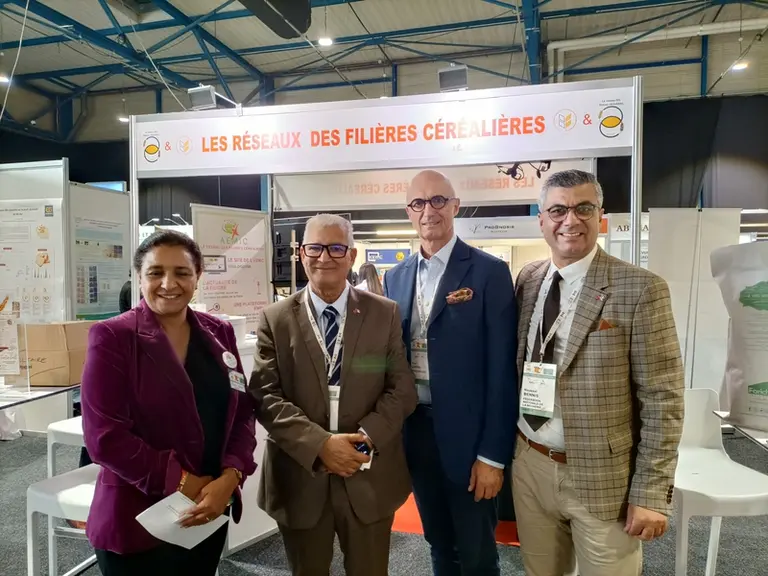
“In a context of rapid climate, technological, economic and societal transformations… cereal sectors must rethink their models and anticipate tomorrow’s challenges. This new edition places an essential question at the heart of the conferences: how can stakeholders in cereal sectors adapt, innovate and seize the opportunities offered by these changes?”, reads the presentation of the program for the 76th Technical Days of the Cereal Industries (JTIC) in Rennes on 3 and 4 November 2026.
Read also l JTIC 2026: cereal industries put adaptation at the heart of the discussions
With this approach as their guiding theme, the 76th JTIC, organized by the Association of Students in Milling and Cereal Industries (Aemic), are structured around three areas: conferences (technical and commercial), scientific posters, and innovations.
Seed genetics and cadmium on our plates
The first part will include four technical conferences (two on Tuesday, two on Wednesday).
On Tuesday 3 November, two technical conferences will take place: first, the French Seed Association (UFS), participating in the JTIC for the first time, will present its activities and work within the Cereals and Protein Crops section, under the leadership of Gilles Lachambre, president of that section.
Then Laurent Druesne and Sophie Rousseau, from RAGT Semences, will provide an overview of recent genetic advances.
Next, Arvalis will explain “why and how cadmium ends up on our plates.” It will be presented by Christine Bar L’Helgouac’h, head of the Institute’s Quality and Product Valorization Department.
The legume/cereal combination and cooperation between artisanal intelligence and artificial intelligence
On Wednesday 4 November, Inrae will present its recent work on “wheat-legume associations: from field to plate,” still hosted by Christine Bar L’Helgouac’h.
Next, the International Association of French Bread (AIPF, whose purpose is to foster exchanges across the wheat-flour-bread sector, helping to promote French bread and all quality breads around the world) will explain how “the hybridization of artisanal intelligence and artificial intelligence is reshaping the wheat-flour-bread sector,” arguing that AI does not replace the artisan but “shifts value, redistributes roles, and obliges the entire sector to rethink its model.”
It will be hosted by Hubert Chiron, honorary president of the AIPF and head of the Inra experimental bakery in Nantes.
Six commercial conferences over two days
The Tuesday 3 November five commercial conferences will also be part of the day for professionals attending the JTIC.
Stay up to date in real time!
Follow topics, legislative projects, companies, and public figures to be notified as soon as we publish an article.
Légumi’Pulse, a specialist in plant-based proteins and flours, will kick things off with a speech on how legumes can become a driver of innovation at the heart of the bakery, viennoiserie, and pastry sector in response to changing consumer expectations.
Next, Assertis, a specialist in technical analysis, will examine wheat purchasing in the face of price volatility, or how expertise in agricultural markets, neuroscience and artificial intelligence boosts mill competitiveness.
Fermentation specialist Lesaffre will continue by offering ways to challenge misconceptions about bread, nutrition and health, comparing consumer perceptions with scientific realities.
Haver France will address high-performance flour bagging, with innovations to improve sanitary quality and safety.
Finally, the French Yeast Trade Association (CSFL) will discuss fermentation, presenting the dedicated Afnor standard and the issues involved in reducing salt in bread.
The Wednesday 4 November will feature a final commercial conference by AIT Ingrédients on “new enzymatic synergies: economic gains for the BVP sector.”
Scientific posters and a showcase of innovation
Scientific posters, displayed over the two days, provide an opportunity to “showcase research work, projects, products, services, or scientific or technical advances” carried out by professional stakeholders from across the upstream and downstream sectors. A first in 2026: each poster—seven planned as of 20 October 2026—will be presented orally to the conference audience.
The innovation showcase will welcome around ten start-ups with innovative business projects (products, services, processes, technologies, sustainable development) for its third edition in 2026. Two awards, one decided by a panel of industry professionals and the other by the audience, will recognize the two projects that attract the most attention.
Over these two days, participants will also be able to meet and talk with the approximately 80 exhibitors (as of 20 October 2026) in attendance. They can also meet members of two foreign delegations from the milling sector: six people from the Asociación Española de Técnicos Cerealistas/Spanish Association of Cereal Technicians (AETC) and five professionals from Morocco’s Fédération nationale de la minoterie (FNM). Dr. Tobias Priske, director of Arbeitsgemeinschaft Getreideforschung e.V. (AGF) in Germany, will also be attending these JTIC. AGF is a cereal research association that manages research on milling, baking and grain science, and is based in Detmold (North Rhine-Westphalia).
Finally, for the first time, JTIC will welcome the Union française de l’agriculture biologique (Ufab), an organic farming specialist and subsidiary of the Le Gouessant cooperative group. Ufab will present a range of food ingredients (flours and protein-rich textured products, a source of fiber and clean label) made with organic legumes sourced from France.