
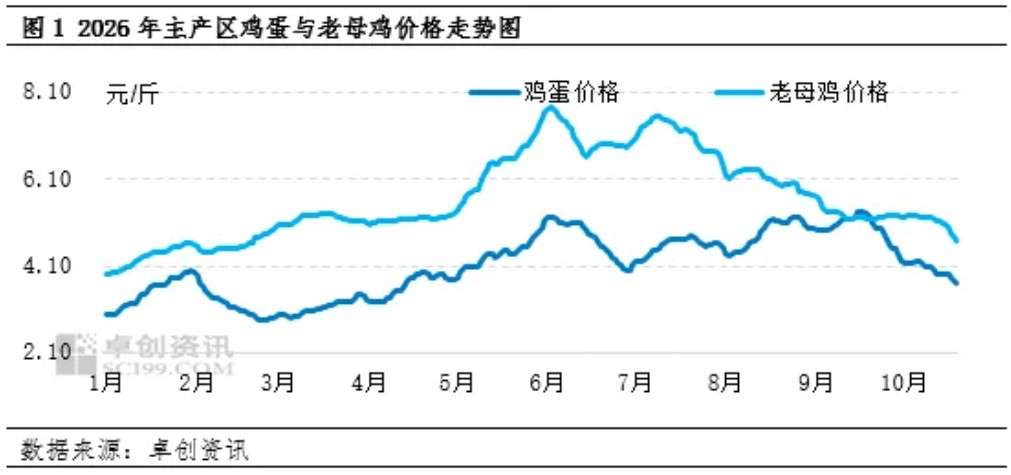
Since mid-2026/9, the domestic layer market has experienced an unusual divergence. Egg prices in major production regions have fluctuated downward, with the speed and depth of the decline rarely seen during the same period in recent years. In sharp contrast, prices for older hens remained relatively stable in the earlier period and did not fall in tandem with egg prices. However, after mid-10, older hen prices fell markedly to catch up, and eggs and older hens shifted from “diverging” to “declining in tandem.” Behind this was a substantive change in farmers’ attitudes toward culling as breeding profits narrowed.
Egg prices: Ample supply and demand, coupled with pessimistic sentiment, deepen the ongoing decline
The core reason for the current round of egg price declines is the continued strengthening of the supply-outstripping-demand imbalance. On the supply side, although the number of laying hens in production has declined month on month since 9 month, pullets placed earlier have gradually begun laying, so the overall supply of eggs remains ample. On the demand side, after stockpiling for the Mid-Autumn Festival and National Day holidays ended, end-consumer demand entered its seasonal off-season. Food manufacturers substantially reduced their purchases, sales at supermarkets and agricultural markets slowed, and traders generally adopted low-inventory, rapid-turnover strategies amid falling prices, further amplifying the contraction in demand.
Price data show that the average egg price in major production regions fluctuated downward from 9 month, when it was 5.36 yuan per jin, and had fallen to 3.70 yuan per jin by 10 month 19, a cumulative decline of 30.97%. More importantly, market sentiment has shifted. After egg prices fell below 4.00 yuan per jin, market participants generally turned pessimistic about the outlook. With the “buy on rises, not on declines” mindset prevailing, downstream purchasing continued to shrink, shipment pressure in production regions kept building, creating a negative feedback loop of “falling prices—reduced purchasing—increased inventories—further price declines.” The current price of 3.70 yuan per jin has fallen below the psychological threshold for most farmers, and the market lacks an effective signal that prices have bottomed out.
Old laying hen prices: From resisting declines to catching up with them, the mindset around culling spent hens is the key variable
From the middle of 9 to the middle of 10, old laying hen prices showed clear resistance to declines. During this period, prices for old laying hens edged down from 5.23 yuan/jin to 5.05 yuan/jin, a drop of only 3.44%, in sharp contrast to the decline of more than 30% in egg prices. The fundamental reason for this resilience during this period was that profits at the farming end continued to provide support. When egg prices were still around 4.00 yuan/jin, farming companies were still making some profit per jin of eggs. There was little urgency to cull old hens, the pace of sales remained relatively steady, and there was no concentrated increase in supply of old laying hens, allowing prices to remain relatively stable.
However, as egg prices continued to hit new lows, breeding profits were further squeezed, bringing about a fundamental shift in culling sentiment. This was especially true for older hens with a markedly declining laying rate: the marginal returns from continued rearing had turned negative, and farmers’ willingness to bring them to market quickly increased significantly. After mid-10 month, the number of older hens brought to market increased markedly. The surge in supply directly put pressure on prices, and older-hen prices subsequently fell to catch up, dropping to 4.69 yuan per jin by 10 month 19 day, with the cumulative decline widening from 5.23 yuan per jin to 10.33%. The shift in culling sentiment from “holding out for a better price and reluctant to cull” to “accelerating market shipments” became the key driver behind older-hen prices turning from stable to falling.
Outlook: Egg prices are likely to remain under pressure, and prices for spent hens still have room to fall.
Looking ahead, egg prices remain unpromising. On the one hand, the pattern of strong supply and weak demand is unlikely to reverse in the short term. The increase in newly laying hens is still coming onto the market, while end-consumer demand is in a seasonal lull, with few factors to boost demand. On the other hand, market participants are generally pessimistic about the outlook. Some parts of the supply chain are even showing a tendency to artificially push prices down and force the culling of older hens, further intensifying the bearish market sentiment.
As for the price of spent hens, with egg prices remaining low, poultry farmers are becoming increasingly willing to cull hens, and the trend of rising sales volumes is now established. Given limited capacity on the demand side, spent hen prices are expected to fall further, with a further decline of 0.30-0.50 yuan/jin expected. It is worth noting that if egg prices continue to drop sharply, this may trigger concentrated culling by poultry farmers, in which case the downward pressure on spent hen prices will become more pronounced.
In summary, the divergence and subsequent reconvergence between the egg and spent-hen markets in this period is essentially a process of transmission through the industry chain driven by changes in farming profitability. A sharp drop in egg prices squeezes profits; narrowing margins force more hens to be culled; and the increased volume of culling, in turn, puts downward pressure on spent-hen prices. The onset of this chain marks the industry’s shift from a “holding prices and waiting” phase to a phase of “passive capacity reduction.” For producers, the current priority is to rationally assess the structure of their flocks and plan culling schedules appropriately, avoiding concentrated culling when prices are at a low. For traders, it is important to be alert to inventory risks as egg prices continue to decline and to maintain the flexibility of operating with low inventory.