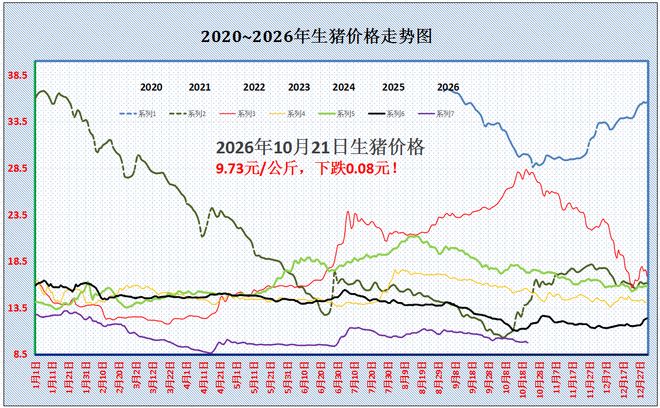
Time flies, and 10 is moving into its latter part; the traditional “Golden September and Silver October” period is also drawing to a close! It is reported that since the third quarter of this year, the live hog market has remained in a low-level tug-of-war. Although the market had expectations for the consumption outlook during 7-8 and live hog prices rebounded repeatedly, price increases lacked momentum because follow-through demand was weak and supply-side pressure was released all at once! In particular, at the end of 8, supported by the start of the school year, domestic standard hog prices briefly rose to 11.09 yuan/kg. Unfortunately, since the beginning of the “Golden September and Silver October” period, the market has pulled back from its highs. Moreover, hog prices remained sluggish during the traditional Mid-Autumn Festival and National Day holidays. After National Day, hog prices fell further through key levels, and farming entered a period of deep losses!
According to monitoring by an industry organization, as of 10 21, the national average ex-farm price for lean-type standard hogs was 9.73 yuan/kg, down 0.08 yuan from the previous day. Hog prices fell under pressure. Compared with the previous high of 11.09 yuan/kg, prices had fallen by a total of 11.3%, with the market experiencing a “cliff-like” drop! Hog prices have fallen back to “pre-liberation” levels, with the “Second Brother” retreating to the level of the second quarter; prices have also hit a new low since the third quarter began! The year-on-year decline widened to around 14.12%, and the live hog market was “in the red” across both northern and southern regions!
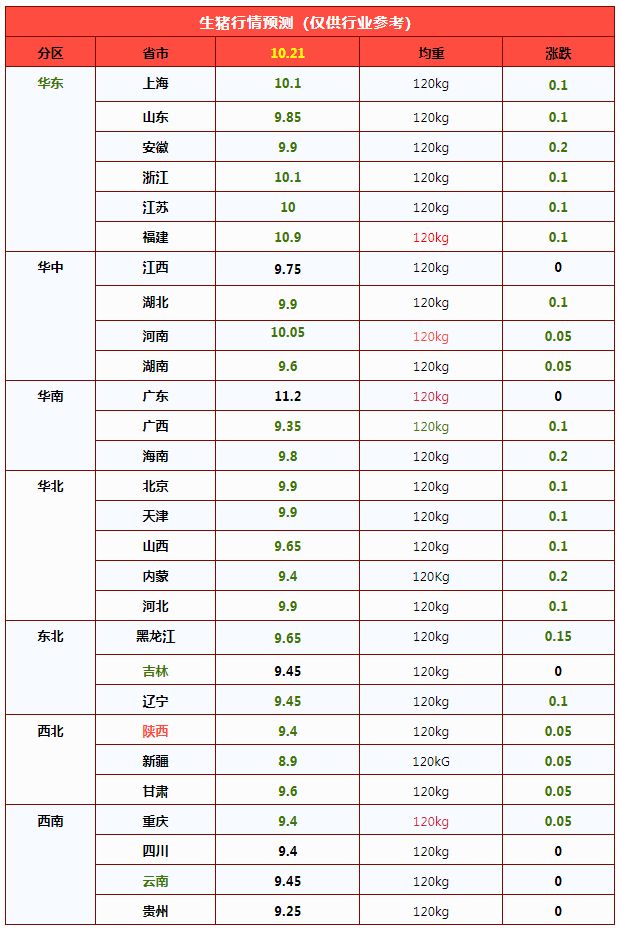
Looking at the regions, among the 7 production areas monitored nationwide in the north and south, the live hog average in the 28 monitored provinces and municipalities was close to Jiangxi’s level. Among the lower-priced areas, Xinjiang bottomed out at 8.9 yuan/kg, while prices in Heilongjiang, Jilin, and Liaoning fell to 9.45-9.65 yuan/kg. Among the higher-priced areas, prices in Guangdong held steady at 11.2 yuan/kg, while prices in Fujian fell below 11 yuan/kg. In the Jiangsu-Zhejiang region, prices fell to 10-10.1 yuan/kg…
At present, the live hog market remains weak as it tests the bottom, and market sentiment is bearish. The supply-demand fundamentals remain imbalanced. In particular, supply-side pressure is “increasing rather than easing,” while marginal demand is “falling rather than rising.” The supply-demand conflict has intensified, and production and sales are facing imbalance!
On the demand side, according to industry research, yesterday, in the major domestic consumer markets of Beijing and Shanghai, quoted prices in Beijing fell by 0.2 yuan, and market trading feedback was subdued, with more unsold stock reported in some markets. The price of white strips in Shanghai fell to around 12.4 yuan/kg, while the volume of hogs brought to market declined, and trading feedback was average! In terms of slaughterhouse operating rates, the operating rate of sampled slaughterhouses yesterday was 30.32%, down 0.08 percentage points from the previous day. Demand was subdued, and the sluggish state of pork consumption continued.
The main factors suppressing a recovery in demand are the economic backdrop and changes in consumption habits, which have led to more substitution in the market. In particular, since the National Day holiday, demand support has been insufficient, and consumption has entered a temporary “lull.” Pork supply remains ample, limiting the willingness to stockpile. Downstream markets are mainly purchasing to meet immediate needs, while slaughterhouses hold high frozen-product inventories and pork from cold storage is gradually being sold, further weighing on a recovery in operating rates!
On the supply side, yesterday, among major regions across northern and southern China, shipments from large-scale pig farms in the northwest and southwest increased, while shipments in east and central China decreased. However, in terms of slaughterhouse procurement, hogs were delivered smoothly to slaughterhouses in the northeast, and scheduled supply was maintained well, with the supply fundamentals remaining ample. In east and central China, hog trading was smooth, and shipments from independent producers and group pig farms were ample, leaving slaughterhouses with little difficulty in sourcing pigs. In south and southwest China, demand follow-through was subdued, and group pig farms were behind on their shipment plans! Bearish market sentiment was strong!
In particular, commercial hog shipment plans continued to increase this month, and the hog market fell into a pattern of “reducing breeding sows but not pork production.” Pork supply was ample, and shipment plans for major large-scale pig farms increased by 1.91%. Shipment plans were progressing slowly during the month, and as the market entered the latter part of the month, producers remained strongly inclined to sell! In particular, amid continued losses in pig farming, the willingness to realize cash remained strong, while feedback on secondary fattening was subdued and new placements were extremely limited. There was little effort to hold back standard-weight hogs, further reinforcing the weak market trend!
Based on this analysis, amid changing supply and demand, hog prices are currently under pressure and trending lower, with the market continuing to fluctuate in search of a bottom. In the short term, the market may lack any substantive support. Pay close attention to changes in market trading activity, especially changes in the pace of sales by major hog producers!
A sharp plunge! Hog prices “collapse” and fall below key levels! Will the rise in 10 be “in vain”?
As 10 moves into its latter part, official information on hog production capacity was recently released in China’s domestic hog market. Regarding the sow inventory, at the end of the third quarter, the domestic sow inventory fell to 3602 ten thousand head, down 10.7% year on year. The sow inventory has fallen below the normal holding level of 3750 ten thousand head, marking substantive progress in reducing production capacity!
However, given the current supply-and-demand balance for hogs, the market continues to follow a pattern of “fewer sows, but no less meat.” In the first half of the year, hog slaughter volume increased year on year, and pork production capacity rose further. Moreover, the release of hog supply driven by existing momentum has yet to run its course, while rising slaughter weights and large domestic frozen pork inventories are exerting downward pressure. As a result, the seasonal turning point for a rise in hog prices is unlikely to materialize, and the hog market is continuing to “grind toward the bottom” and move lower!
As of 10/21, the national average ex-farm price for lean-type three-way crossbred hogs was 9.73 yuan/kg, down 0.08 yuan from the previous day. Hog prices “collapsed” and fell below key levels; the average hog price has already fallen below the monthly low of 9.79 yuan/kg, setting a new low since the start of the second half of the year. The market continues to show a pattern of a peak season that has failed to deliver, with hog prices down a cumulative 12.26% compared with the start of last month!
Specifically, in the national live hog market, the average hog price monitored across the sampled 28 provinces and cities in the north and south was close to that in Jiangxi (9.75 yuan/kg). The live hog market in both the north and south continued its widespread downward trend, with quotes hovering at 8.9-11.2 yuan/kg. In particular, prices in many parts of East China also successively fell below 10 yuan/kg, and mainstream live hog quotes retreated to around 9.4-10.1 yuan/kg. The market has fallen into a “quagmire,” and hog prices face a pattern of “falling without respite”!
At present, I believe the main reason for the decline in hog prices is that the increase in supply is outpacing the growth in demand. With both supply and demand increasing, demand is insufficient to absorb supply, and the production and sales markets remain fundamentally mismatched!
On the supply side, although a sharp reduction in the number of breeding sows is favorable for the hog price outlook 10 months from now, current commercial hog shipments reflect changes in the number of breeding sows 10 months earlier! It is reported that at the end of last year, the number of breeding sows stood at 3961 ten thousand head. In addition, improved sow productivity has offset the effects of production cuts, intensifying the pressure of a temporary supply surplus! In particular, demand was weak in the earlier period, and farms shipped hogs at a slower pace. As the weather continues to cool, fattening hogs are gaining weight faster, increasing the supply of market-ready commercial hogs. Average shipment weight is also continuing to rise, further reinforcing the fundamentals of oversupply!
On the demand side, after the National Day holiday, demand fell back in line with its usual seasonal trend, and the operating rate of slaughterhouses retreated to around 30%. However, as the weather gets progressively cooler, seasonal demand is recovering slowly. Pork buying and selling at rural markets in the domestic market have improved somewhat, but the increase in urban demand has been limited, and the rise in slaughterhouse operating rates has been modest. Demand remains insufficient to absorb the available hog supply! Moreover, amid prolonged losses in hog farming and an outlook for excess pork supply, mainstream secondary fattening operators are cautious about entering the market, further dampening expectations of a price rise!
Against this backdrop of changing supply and demand, hog prices are currently under downward pressure. The average price for standard-weight hogs has fallen to 9.73 yuan per kilogram, and the market is showing a pattern of breaking below previous levels. Market sentiment also leans strongly toward either expecting further declines or remaining cautious. In the short term, hog prices may continue to search for a bottom. Key factors to watch are changes in downstream pork purchasing and sales, as well as changes in the pace of sales by major hog producers. In theory, hog prices may continue to fluctuate downward at the end of 10; a rebound may be difficult to materialize.
Expanded Frozen Pork Reserve Rotation Amid Continued Pressure on Hog Prices: An In-Depth Analysis of the Fundamentals of the Current Hog Market
As the fourth quarter began, central and local government frozen pork reserve rotation transactions continued to be put up for auction. Reserve purchases were stepped up, but the market did not see the expected price increases. Some central reserve frozen pork rotation lots remained unsold even after multiple rounds of bidding. Spot prices for live hogs fluctuated at low levels, and the industry entered a prolonged period of deep losses. Despite warning thresholds being triggered and reserve purchases continuing, hog prices remained weak. This was not because the policy had failed; rather, the supply-demand balance in the current hog market had undergone structural changes. Reserve tools can provide only a floor for market sentiment and cannot reverse the fundamentals of strong supply and weak demand.
Operational data on reserve purchases show that this round of frozen pork purchases was mainly conducted through in-storage rotation, with an extremely limited net increase, leaving it unable to reshape the national supply-demand balance. From 7 to 9, central and local authorities listed a combined 11.7 ten thousand tonnes of frozen pork for reserve purchases. The central government conducted 6 rounds of purchases totaling 7.7 ten thousand tonnes, alongside withdrawals for rotation. The volume put into storage largely matched the volume withdrawn, leaving net new reserves of only 800 tonnes. Local purchases totaled 4 ten thousand tonnes and were dispersed across regions. Shandong and Henan accounted for 47% of local purchases, while the average volume per batch in the other provinces was only 1200 tonnes. Against the backdrop of total pork production of 4508 ten thousand tonnes in the first three quarters, the total listed volume of 11.7 ten thousand tonnes represented only 0.26%, too small to disrupt a supply market measured in tens of millions of tonnes.
Trading records from Huachu.com show weak demand for frozen products, with multiple listings of rotation withdrawal lots failing to clear. On 15 9, the first batch of 15500 tonnes of centrally rotated frozen pork had a first-round transaction rate of 74%. After four rounds of bidding, 1200 tonnes remained unsold, bringing the batch’s cumulative failure-to-sell rate to 62%. The 900-tonne rotation batch listed on 19 8 also remained unsold after four listings. The policy purpose of frozen pork reserve purchases is to provide a floor, not to drive prices higher. The lots are frozen products and do not directly anchor live hog spot prices. The policy’s core objective is to curb panic selling by farmers and ease pessimistic expectations when the hog-to-grain ratio falls below the warning range. It is a market-floor management tool, not a policy aimed at actively pushing up hog prices. The new round of bidding for the rotation purchase and withdrawal of 28500 tonnes of central frozen pork on 20–23 10 continues the same rotation-based operating approach.
A supply-side cycle mismatch of “fewer sows but no less pork” has broken the traditional chain through which capacity changes are transmitted in the hog cycle. Under the traditional cycle logic, a decline in the inventory of breeding sows is followed about 10 months later by a contraction in hog shipments, which in turn drives prices upward. However, improved farming efficiency in this cycle has offset the effects of sow herd reduction. At the end of the second quarter, China’s breeding sow inventory stood at 3780 ten thousand head, down 6.5% year on year and only 30 ten thousand head away from the regulatory target of 3750 ten thousand head, suggesting that the apparent reduction in production capacity was nearly complete. However, the industry’s MSY continued to rise: the industry average MSY in 2026 increased from 21.37 head in 2025 to 21.74 head, up 1.74% year on year, while leading farming companies had already reached an MSY of 25 head. Efficiency gains offset the reduction in sows, leaving an equivalent supply decline of only 4.9%, significantly below the apparent reduction of 6.5%.
Supply-side data continue to confirm the oversupply situation: in the first three quarters of 2026, national hog slaughter reached 53739 ten thousand head, up 1.4% year on year, while total pork output reached 4508 ten thousand tonnes, up 3.2% year on year. Combined with the concentrated release of previously held-back large hogs, the average live weight of hogs slaughtered nationwide at the end of 9 was 128.82 kilograms per head, a slight year-on-year increase of 0.21 kilograms, continuing to add to supply. High-frequency data from the slaughtering sector likewise confirm supply pressure: in the first week of 10, large-scale slaughtering companies processed 14.64 ten thousand head per day, up 3.63% from the post-holiday period; from 1 to 7, large-scale slaughter plants nationwide processed a cumulative 26335 ten thousand head, up +22.37% year on year, with the slaughtering operating rate remaining high. Meanwhile, at the end of 9, the frozen-product storage capacity utilization rate at key slaughtering companies reached 32.2%–32.56%, up 14.5–15 percentage points year on year. The corresponding frozen pork inventory stood at 31.7 ten thousand tonnes, a high for the same period in nearly five years. If hog prices rebound above the holding cost of frozen products, existing frozen stocks will be released in concentrated volumes, creating a clear price ceiling. Although imports have contracted, cumulative imports of pork and pork offal from 2026 1 to 8 totaled 128 ten thousand tonnes, down 15.6% year on year. However, this decline is far smaller than the 3.2% increase in domestic pork output and cannot offset the domestic supply glut.
In terms of costs and profits, the industry is mired in an exceptionally long loss cycle, while the cash-flow resilience of leading companies is prolonging the pace of capacity reduction. Monitoring by the National Development and Reform Commission shows that in the first week of 10 month, the hog-to-grain price ratio fell to 4.46:1, below the Level One warning threshold of 5:1. The national average full cost for self-bred and self-raised pigs was 14.2 yuan/kg (7.1 yuan/jin), with feed costs accounting for 62%; costs varied markedly among leading companies, with the lowest reaching 11.5 yuan/kg (5.75 yuan/jin). As of the end of 9, the self-bred and self-raised model was losing nearly 195 yuan per head, while fattening purchased piglets was losing about 117 yuan per head. This industry downturn began in 2025 year 10 month; by 2026 year 9 month, the industry had been losing money for 14 consecutive months, with an average cumulative loss of 1860 yuan per head, 22% higher than the cumulative loss over the same period in the previous cycle of 2021-2022. Supported by the cash flow of leading pig-farming companies, the active culling of inefficient capacity has proceeded 30% more slowly than in the previous cycle, significantly delaying the pace of involuntary capacity reduction. From 7 to 9 month, the average live hog price was 5.42 yuan/jin. Demand was weak during the traditional peak consumption season around the Mid-Autumn Festival and National Day holidays, and live hog prices fell further to around 5 yuan/jin in mid-10 month.
On the demand side, the decline in medium- and long-term consumption patterns is suppressing price elasticity, while fourth-quarter stockpiling for cured and preserved meats can only provide a short-term pulse. Pork's share of domestic meat consumption has continued to fall, from 2018 year 62% to the current 58%; chicken, beef and lamb continue to divert consumption. Demographic changes and shifts in dietary preferences are gradually lowering the baseline for total pork demand. Even when fourth-quarter stockpiling for cured and preserved meats begins, it is unlikely to generate sustained incremental demand. The proportion sold fresh remains at the usual 82% level, with no seasonal spike. Hog futures likewise signal pessimistic expectations: the 2611 contract has fallen nearly 14.5% from its 9-month high, and the current forward price is at a discount of about 0.8 yuan per kilogram to the spot price, reflecting the industry's assessment that supply pressure has yet to ease.
Overall, there is little basis for a sustained rise in hog prices in month 10. The reserve policy can only shore up market sentiment; it cannot reverse the supply-and-demand fundamentals. The trigger for a reversal in the hog cycle lies not in reserve-purchase announcements, but in the progress of actually exiting inefficient production capacity, the extent of supply contraction resulting from herd optimization, and the strength of marginal recovery in consumer demand.
For the livestock industry, it is unrealistic to hope that policy support will lift pig prices. The focus of industry operations should shift to proactively removing low-efficiency sows, optimizing herd structure, and continuously reducing costs and improving efficiency. Only when capacity reductions effectively translate into a decline in hog marketings and the supply-demand balance is restored can the industry hope to emerge from this deep-loss cycle.