France
French pig market: regaining competitiveness
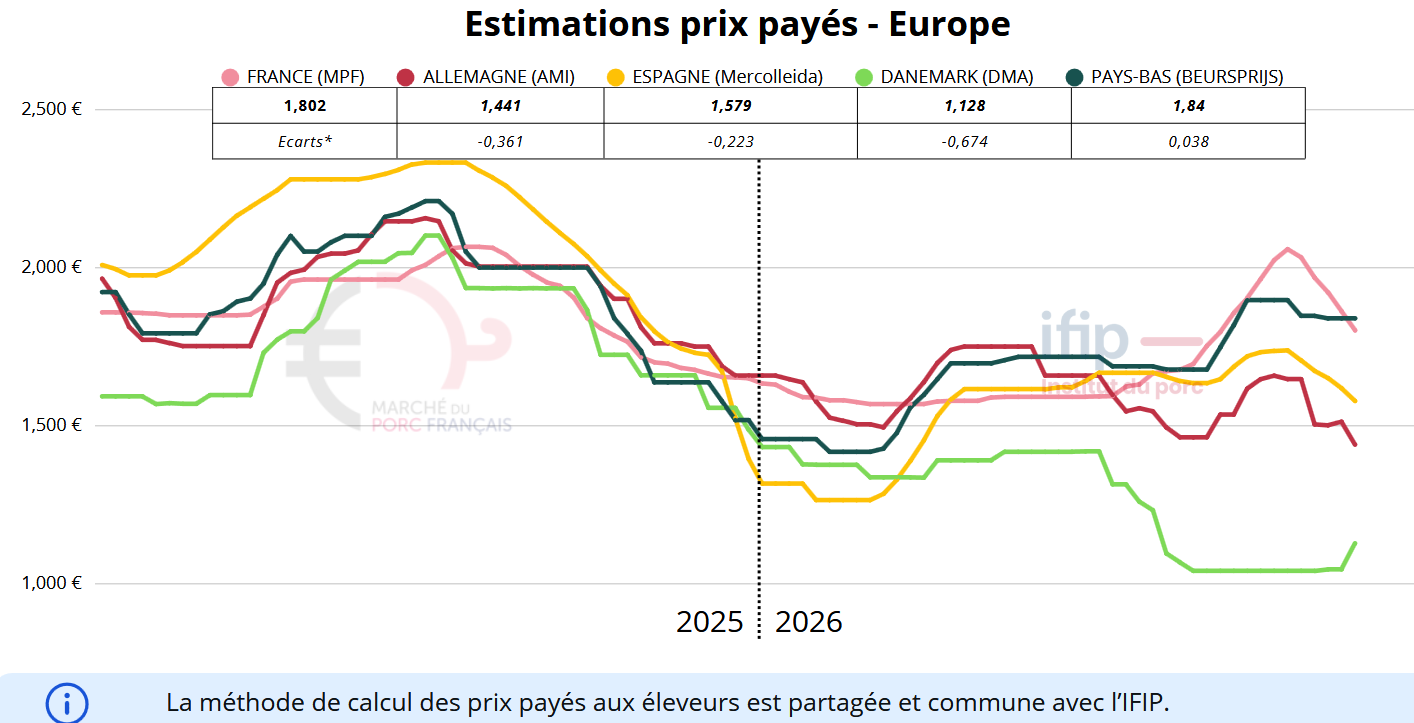
Last week again, the French Pig Market recorded the maximum decrease in the average auction price across the two sales sessions, a decline of 6 cents. This position remains unanimous among buyers, reflecting their desire to regain competitiveness against other European operators; otherwise, their activity volumes remain limited. Faced with rising weights, sellers offer no resistance, preferring smooth departures of pigs.
Uniporc: a new market balance
Since mid-September, a new market balance has taken hold. The supply of pigs remains low and fluctuates each week around 350 000 pigs in the UNIPORC area, a level approximately 15 000 pigs below that of 2025. While this decline in supply could support prices, the lack of competitiveness compared with European slaughterhouses is prompting French facilities to reduce their needs. This situation ultimately creates a surplus of supply, resulting in rising weights and longer collection times.
European Union
The German market is under renewed downward pressure, and the VEZG price falls by 5 cents to 1,40 €/kg. Slaughter numbers rise to 745 202 pigs after the week disrupted by the public holiday, while weights increase to 98,6 kg. Supply remains abundant, and major slaughterhouses have requested a price adjustment to maintain throughput. Despite more promotions, the meat trade still lacks momentum, and cut prices are changing little. The situation remains fragile, with a risk of further pressure.
In Spain, pig prices fell again, but the live market now appears better balanced. Slaughterhouses remain keen to buy, and available animals are finding buyers. Meat marketing remains difficult, however, although recent cuts in cut prices have provided some support. A stabilization of the quotation had become conceivable, but fresh price cuts in neighboring European countries quickly rekindled the pressure.
The Belgian market remains broadly balanced, despite relatively ample supply. Pigs generally continue to find buyers, although some surpluses are emerging locally. The main difficulty remains the meat trade, which, combined with the decline in Germany, is keeping pressure on the Belgian price.
In Italy, the downward trend is now under way and continues, and could even intensify in the coming weeks. The supply of pigs has increased and now meets the needs of slaughterhouses. As in France, the price differential with the rest of Europe is increasing pressure on the domestic market, particularly in the face of competition from imported meat at more competitive prices.
United States and China
The U.S. market continues its decline, with a 2,1 % drop in pig prices and a 2,8 % drop in the value of cuts. Slaughterings reach 2,63 million pigs, a level comparable to 2025. Despite stable production, meat is losing value. Competition from cheaper chicken appears to be weighing on consumption and keeping pressure on prices.
The Chinese market remains oriented downward despite the national holidays. The price of live pigs has fallen by 0,5% and that of meat in wholesale markets by 1,8%. Wholesale prices are now 15,5% lower than those at 2025. Consumption remains insufficient to absorb the still substantial supply, keeping prices under pressure.