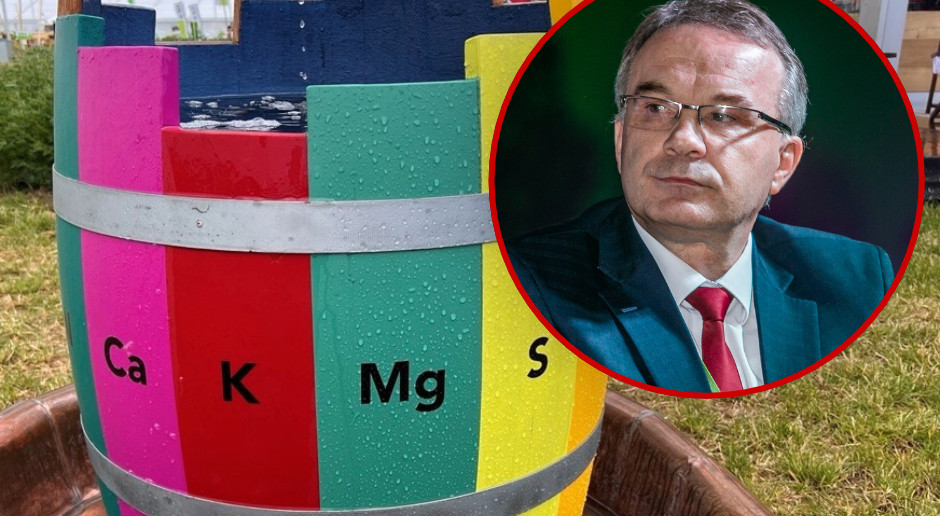
- The next edition of the National Challenges in Agriculture conference is coming up! On 18 November, we will meet at Legia Stadium in Warsaw.
- We will discuss what matters most to farmers today: the profitability of production, costs, and ways to achieve a stable yield.
- Agronomy, as every year, will be one of the conference’s pillars. Once again, we will be joined by Prof. Witold Szczepaniak from UP in Poznań.
- Register for National Challenges in Agriculture 2026! Participation is free for farmers.
- Check the program and join the discussions about the future of Polish farms!
Rising fertilization costs, drought, and increasingly unpredictable weather pose a difficult challenge for farmers: how can they protect the yield potential of varieties without adding unnecessary production costs?
Dr. hab. Witold Szczepaniak, professor at the Poznań University of Life Sciences, will talk at the National Challenges in Agriculture about how to fertilize effectively and build a stable yield in conditions of weather roulette.
A variety’s potential does not guarantee a high yield
Modern crop varieties have high yield potential, but its practical realization remains limited. According to research cited by Professor Witold Szczepaniak, around 50–55 percent of the biological potential is realized in high-input cereals, including wheat. In extensive cereal cultivation, this figure is only 35–40 percent.
As a result, average wheat yields in Poland in recent years have only slightly exceeded 5 t/ha. Meanwhile, the best producers achieve results up to twice as high in favorable weather conditions.
So how can the potential encoded in a variety’s genetics be translated into yield per hectare? Choosing a good variety or increasing fertilizer rates is not enough. The technology must be matched to the soil, the fertility of the site, water availability, and weather conditions. And with production costs high, it is equally important that the expenditure incurred delivers the expected results.
More expensive fertilizers, greater risk. Effectiveness matters
Fertilization is one of the most important elements of production technology, but its effectiveness depends on many factors. Even a correctly selected rate will not deliver the expected result if the plant does not have the right conditions for nutrient uptake.
“Realizing the yield potential of cultivated plants requires agricultural producers to manage a range of production factors, including those related to fertilization. At the same time, in conditions of weather roulette, which have characterized recent years, the measures taken must be highly flexible,” emphasizes Professor Szczepaniak.
This is an important tip for farms that need to balance yield ambitions with economic considerations. Fertilisation effectiveness is determined not only by the amount of nutrients supplied, but also by their availability to plants and the ability to make use of their potential in specific field conditions.
You can’t plan everything in advance
Variable weather makes it difficult to decide both on application rates and on the timing of fertiliser applications. A strategy that works in one season may not produce the same results in the next.
“You can’t plan the application rate, choice of fertilisers, or the timing and methods of application in advance,” the expert points out.
That is why farmers should assess the situation in their fields on an ongoing basis and adapt their actions to current conditions. Soil nutrient status also matters, as it can vary considerably even within a single farm.
Prof. Szczepaniak at NWwR: from fertilisation to a stable yield
Dr hab. Witold Szczepaniak, prof. UPP, from the Department of Fertiliser Fundamentals and Systems, the Chair of Agricultural Chemistry and Environmental Biogeochemistry at the Poznań University of Life Sciences, will discuss how to make fertiliser decisions amid rising production risks.
His lecture, “How can we fertilise to protect the yield potential of varieties amid weather roulette?” will take place during National Agricultural Challenges as part of the session “Variety, fertilisation, crop protection. How to build a stable yield?”
The professor will also take part in the debate “From Potential to Yield. How to Design Technology for Every Hectare?”. Together with experts from the seed, fertilizer and technology industries, they will discuss how to match a variety to the site, optimize fertilization, manage water efficiently, and protect crops from diseases, pests and weather stress. The aim is a stable yield and rational input costs, tailored to the conditions in the field.
Would you like to fertilize more effectively and build a stable yield?
Come on 18 November to NWwR at Legia Stadium in Warsaw. Gain practical knowledge and talk with experts. Admission is free for farmers, but advance registration is required.
Sign up today!