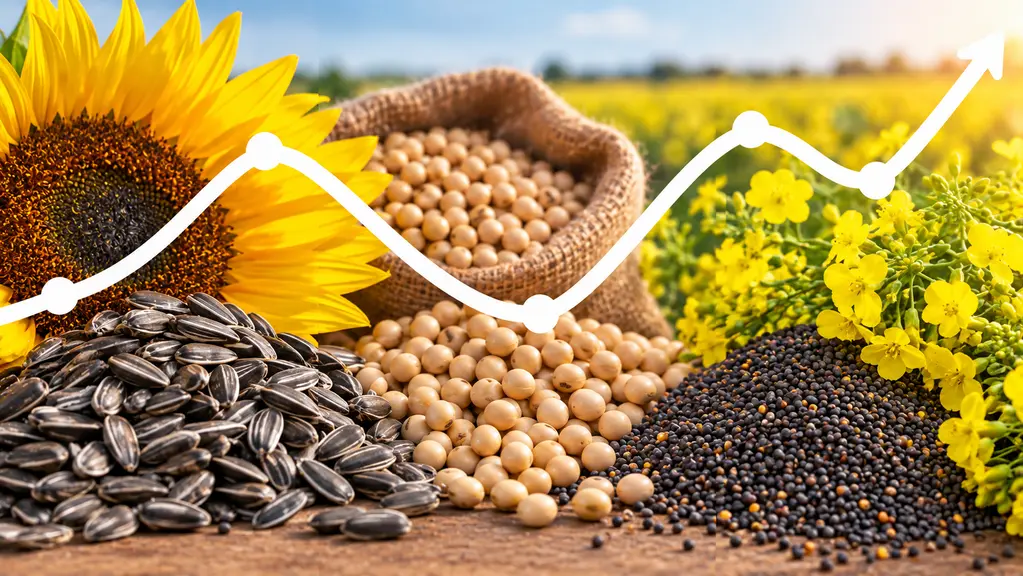
Rapeseed and soybean prices on both the physical and futures markets fell between 12 and 19 October 2026, while sunflower quoted in France rose.
Rapeseed prices down this week
Rapeseed prices on Euronext fell over the period from 12 to 19 October 2026, dropping from 552,25 €/t to 546,50 €/t for the February contract (− 5,75 €/t). The November 2026 contract (last trading day on 31 October) is now driven by position liquidations, with wide price swings from one session to the next. Moselle FOB rapeseed also fell (− 15 €/t, to 548,50 €/t) for the January–March period. In this highly volatile market from one week to the next, few deals are being made, with oilseed prices also moving in line with oil prices. In France and Europe, farmers are already heavily committed to the campaign, and grain users are already well covered. Furthermore, Canadian canola origin is becoming more pressing in terms of price on international markets.
Sunflower price trends in France
The price of high-oleic sunflower delivered to Saint-Nazaire, their benchmark position on the French physical market, rose over the week from 12 to 19 October 2026, to 610 €/t (+ 17,50 €/t) for the October–December period. Deals are being concluded, but in limited volumes given the low production this year. As for the harvest, the average yield of 15-16 q/ha appears to be holding at the national level. Oil content in the first samples analyzed appears to be around average, but operators point to the difficulty of processing very small, very dry seeds, which are sometimes empty.
Soybean prices fell this week
In Chicago, soybean prices on the CBOT edged down slightly between 12 and 19 October 2026, falling from 1 287,75 cts$/bushel to 1 253,50 cts$/bushel for the November 2026 contract, the second most traded (- 34,25 cts$/bushel). For the January 2027 contract, now the most traded, the bushel was trading at 1 268,75 cts$ on Monday evening. Crushing activity is robust in the United States to meet strong global demand. With less rainfall in recent days and in the days ahead, harvesting has resumed at a pace that allows processing plants to be adequately supplied. Sowing forecasts in Brazil are progressing at a good pace. Chinese buyers are back and have made a series of purchases over the past week.
Stay up to date in real time!
Follow topics, legislative projects, companies, and public figures to be notified as soon as we publish an article.
Price drop in protein crops
This week, the prices of forage peas and faba beans show a slight decrease delivered Pontivy-Guingamp, between 7 and 14 October 2026. From the East, however, feed pea quotations are gaining ground. It should nevertheless be borne in mind that these quotations are nominal and concern very small volumes. Activity is focused on yellow peas for supplying human food factories, as the price of yellow peas is more attractive than that of feed peas. The latter has also gained 10 €/t delivered Marne.
The production of protein peas at 2026, estimated on October 1st, 2026, at 471 000 t (compared with 467 000 t on September 1st, 2026, and 589 000 t in 2025), would be close to the level of 2013, according to Agreste estimates as of October 1st, 2026. “It would be 23% below the 2021-2025 average due to declining acreage (150 000 ha in 2026 compared with 162 000 ha in 2025) for the third consecutive year, while yields, although down year on year at 31,5 q/ha (compared with 36,4 q/ha in 2025), would remain at the five-year average level. This decline in the harvest is pulling down the production of all the main protein crops (peas and faba beans), which is expected to be 10% below the 2021-2025 average, despite the strong momentum in faba bean sowings (120 000 ha in 2026 compared with 112 000 ha in 2025), which have risen continuously since 2023,” the government agency comments. Faba bean production stands at 267 000 t in 2026 (compared with 285 000 t in 2025), with a yield of 22,3 q/ha (compared with 25,4 q/ha).
This article was written by the specialist journalists at La Dépêche-Le Petit Meunier, which has been supporting grain-trade operators since 1938.