
Feed management and feeding techniques help ensure that poultry receive the right amount of nutrients at the right time.
Although this article focuses mainly on feed management, do not overlook water management.
If birds do not drink enough water, their feed intake will not meet their needs, and they will not be able to grow or produce normally according to their genetic potential.
Other factors affecting feed intake include feed structure, health status, and environmental conditions.
Feed management begins when chicks or pullets enter the house.
Feeders and drinkers should be filled in advance and placed where they are easy to find, encouraging 1-day-old chicks or pullets to eat and drink.
To monitor whether feeders and drinkers are easy for chicks to find, check the chicks’ crop fill.
About 10 hours after placement in the poultry house, approximately 80% of chicks should have both water and feed in their crops; after 24 hours, this proportion should increase to at least 95%.
Especially for chicks aged 1 days, adding extra feeders and drinkers during week 1, or setting up a smaller brooding area, helps chicks find the drinking and feeding equipment more quickly.
As the chicks continue to grow, increase the floor-rearing area or cage space in a timely manner.
Ensure that the extra drinkers and feeders are gradually removed, giving the chicks enough time to adapt to the automated feeding and drinking equipment.
As the chicks get older, also pay attention to the height of the drinking lines and adjust it promptly as needed.
Always ensure that the birds can eat and drink comfortably!
As mentioned earlier, water is an important nutrient and may even be the most important nutritional factor.
Under normal circumstances, birds drink approximately 1.5 to 2.0 times as much water as they consume feed.
A lower water-to-feed ratio usually leads to reduced feed intake, thereby affecting growth, egg production, and reproductive performance.
Water should be readily accessible, clean, fresh, free of off-odors, and free from contaminants.
— 1 —
Feed structure
Checking only the label information of the feed supplied may lead you to overlook the importance of feed structure, which can have a major impact on feed intake and nutrient utilization.
For mash diets, a simple sieve analysis can be used to check the feed structure before it enters the feeding system.
For pelleted or crumbled diets, testing is a little more difficult, and wet sieving is recommended to check the feed structure.
As a rapid testing method, some pellets or crumbles can be dissolved in water. Once the feed has completely dissolved, observe the proportion of coarser particles, since a similar dissolving process occurs after the feed is consumed and enters the crop.
You may be wondering why feed structure is so important.
First, feed that is too fine (particle size less than 0.5 mm) may lead to insufficient feed intake, because poultry take more time and find it more difficult to consume these dust-like particles.
In addition, chicks, pullets, and laying hens all have a gizzard, a muscular grinding organ unique to birds.
Muscle tissue can develop fully only when stimulated.
Therefore, coarser feed (particle size greater than 1.0 mm) should be used to stimulate gizzard development.
At the same time, a sufficiently stimulated gizzard can lower its internal pH.
Since protein digestion begins in the gizzard under low-pH conditions, a well-developed gizzard that has been sufficiently stimulated by a coarse-particle diet helps with protein digestion, thereby improving hens’ feed efficiency.
On the other hand, a diet with particles that are too coarse may also have negative effects.
This can easily lead to uneven feed and segregation during transport, inside the bin, or in the feeding system, or cause birds to feed selectively.
For birds that have not been beak-trimmed, the risk of selective feeding is even higher.
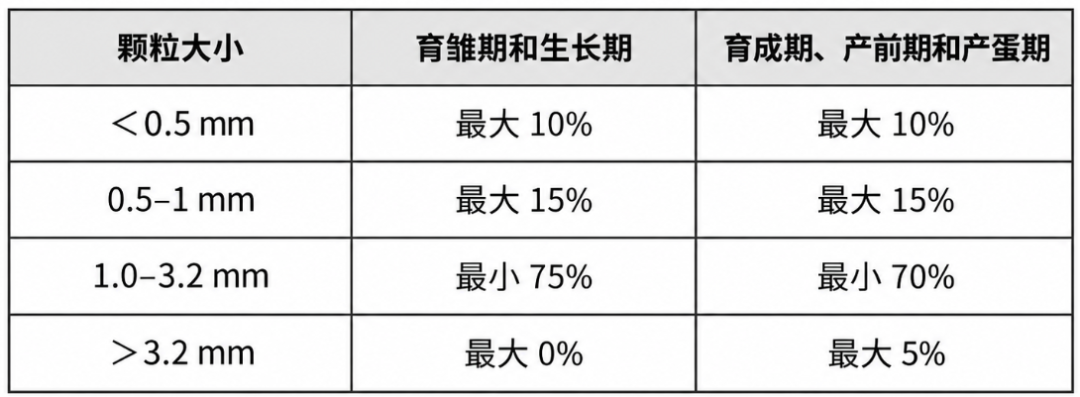
In short, most feed particles should be between 1.0 and 3.2 mm in size, and it is preferable to narrow the particle size distribution further.
See Table 1 for the specific recommended standards.
Table 1—Recommended feed particle size standards for mash diets
— 2 —
Feeding time
When scheduling feeding times, the birds’ “natural” feeding patterns should be taken into account.
This means that it is recommended to schedule 60% of the feed for the afternoon, with a smaller proportion of the feed supplied in the morning.
For breeder producers, attention should be paid to the flock’s mating behavior.
Mating activity occurs mainly in the afternoon, so the flock’s mating behavior should not be frequently disrupted by the feeding process.
— 3 —
Feeding technology
The empty-feeder technique is very important for preventing smaller feed particles from accumulating in the feeding system.
By applying the empty-feeder technique, it is possible to ensure that birds consume a complete proportion of the daily ration each day.
As mentioned earlier, feed uniformity and feeder space also affect total daily feed intake.
In cage systems, feeder space is often insufficient to allow all birds to eat at the same time.
Block feeding—that is, two consecutive feeding periods with a short interval between them—can improve feeding uniformity issues caused by competition for feeder space.
With block feeding, the feeding needs of dominant birds are met first. When the dominant birds begin drinking, subordinate birds can start eating and will receive a newly supplied batch of feed containing coarser particles.
Otherwise, dominant birds tend to preferentially consume the coarser particles, which mainly contain energy; subordinate birds, in turn, consume more protein and amino acids, which are usually found in smaller particles.
Therefore, dominant birds face an increased risk of fat deposition because they consume more energy. At the same time, insufficient protein intake may reduce their egg production and result in smaller eggs.
In open farming systems, an excessively long feed delivery chain can also cause similar problems, as this usually leads to the segregation of feed particles.
— 4 —
Feed intake
If feed can be supplied uniformly to the poultry, then we have achieved the final factor affecting uniform and adequate feed intake: daily feed intake.
Feed intake is affected by many different factors, including: ambient temperature; health status; breed; feed nutritional specifications; and feeding techniques.
Generally, in high-temperature or high-humidity environments, poultry feed intake decreases; feed intake also decreases when the poultry's health status declines.
However, this does not apply in cases of chronic enteritis, as digestion slows down at this time, which may lead to increased feed intake.
To reduce the negative impact of a decline in feed intake, the nutrient concentration of the feed can be increased.
Usually, unless restricted by external factors (such as climate or health conditions), laying hens regulate their feed intake according to the energy and amino acid levels in the diet.
The final factor is feeding technique. Feed structure and feeding with an empty trough were discussed earlier.
Additionally, if regulations permit, midnight feeding can help increase feed intake and improve eggshell quality.
The specific method is to provide 1.5–2 hours of light during the middle of the night, while ensuring that the birds have free access to feed and water.
Because feeding takes place in a lower-temperature environment at this time, and there is less food in the poultry's digestive systems, daily feed intake increases.
Of course, floor space, feeder space, and the number of nipple drinkers per bird differ significantly between cage systems and alternative rearing systems, and each presents different challenges.
However, there are also differences in energy requirements and feed intake between the two systems.
Using the cage system as a reference (100%), compare the performance of white-feathered and brown-feathered laying hens in other housing systems:
The main factors that increase energy requirements include increased activity and changes in ambient temperature.
Because brown-feathered laying hens have a higher body weight, they require more energy than white-feathered laying hens to maintain daily activity and basal metabolism.
Under cage-rearing conditions, these differences are not pronounced because activity is restricted. However, when transitioning to cage-free systems, differences in feed intake become very pronounced, as illustrated in Table 1.
Since egg production quality (total egg weight produced) is similar across different rearing systems, amino acid requirements do not vary significantly between systems.
Note: This article is sourced from the Zootecnica website. Diogo Ito, Nutritionist, Hendrix Genetics Layers