Image source: Internet
In mid-10, quotations for white-feather broilers appeared to have “stabilized.”
According to China Poultry Disease Network’s national white-feather broiler live-bird quotations for 10 16, the farm-gate prices in Fushun, Shenyang, and Dalian, Liaoning, were all reported at 3.35 yuan per jin; prices in Xinxiang, Luohe, and Shangqiu, Henan, were reported at 3.10 yuan per jin; Linyi, Shandong, at 3.15 yuan per jin; and Binzhou at 3.12 yuan per jin. The national average was 3.28 yuan per jin, with prices in the vast majority of production areas showing a change of “0.00” from the previous day. On the same day, the national average price of white-feather broiler chicks was 2.21 yuan per chick; Jinzhou was 2.35 yuan per chick, Yantai 2.30 yuan per chick, and Weifang 2.15 yuan per chick.
Prices are stable. But that stable level remains a cruel distance from the cost line for farmers.
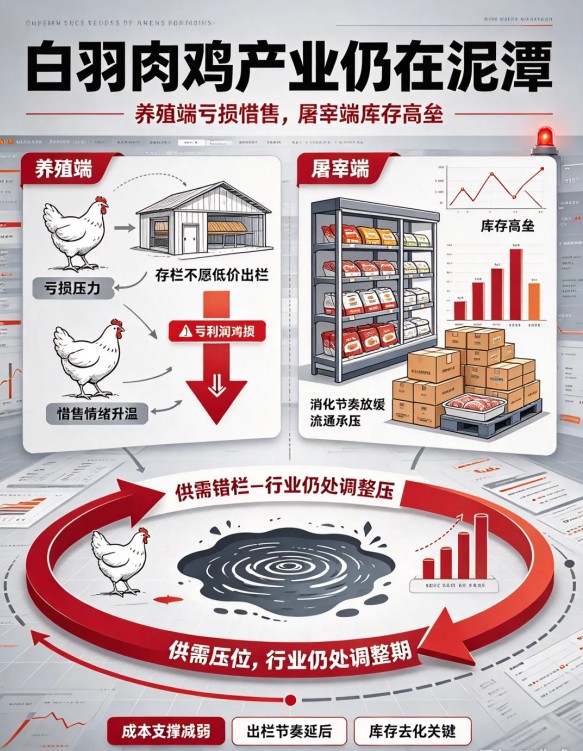
At the farm level: losses have made “holding back sales” a form of forced endurance
Weekly market data from 鸡病专业网 show a striking comparison: In the first week of 10月 (10月1—8日), the weekly average price of white-feather broilers in major production areas nationwide was 2.97 yuan per jin, while the full cost of raising broilers ranged from 3.10 to 3.30 yuan per jin. The average price remained below the cost line, leaving producers broadly in the red. Another set of weekly monitoring data is more direct: the industry's full cost of raising white-feather broilers was approximately 3.2 to 3.4 yuan per jin, against a current price of 2.93 yuan per jin, putting the loss per broiler in the range of 0.8 to 1.3 yuan. This is only an estimate based on weekly averages. The experience reported by people on the ground is much grimmer: in Shandong, commercial broiler producers faced high chick prices earlier on top of rising feed costs, pushing the overall cost per broiler above 3 yuan. Both contract-raised and independently raised broilers were losing money, with losses per bird generally exceeding 3 yuan and reaching more than 4 yuan in some samples.
The chick segment is also bleeding at the same time. From 9月11—18日, the weekly average price of white-feather broiler chicks was only 1.64 yuan per chick, down 0.58 yuan week on week, a decline of 26.13%; it was nearly half the year-earlier level. Meanwhile, the floor for hatching costs remained above 2.80 yuan per chick, and hatcheries lost 0.7 to 0.75 yuan per chick in 9—10月. From hatching through raising, a broiler passes through two stages of losses, with no cushion anywhere along the entire supply chain to offset the risk.
Under this cost structure, the so-called “holding back sales” has taken on a different meaning. Normally, producers hold back sales because they expect prices to rise and deliberately keep broilers on the farm until prices improve. But when losses per bird are 3 to 4 yuan, holding back sales is more often a passive choice imposed by asset specificity: once poultry houses and equipment sit empty, fixed investment yields nothing and cash flow stops outright. Continue raising broilers, and the bet is on a turnaround in the next flock's market; stop, and both prior investment and the right to keep raising broilers are written off at once. As a result, many small and medium-sized farms keep sending broilers to market while continuing to bleed money. Beneath the appearance of “holding back sales” lies a war of attrition with no way out.
Slaughtering sector: A capacity utilization rate of 90% is not a warning sign; it is the norm
Broiler chickens are cheap, so raw material costs at the slaughtering end should look favorable. In the middle of 9, the operating rate of sampled slaughtering enterprises once rose to 83.73%, and the theoretical profit per bird from low-priced broiler chickens approached 2 yuan. But there is a cold store between book profits and actual cash flow.
According to monitoring data from the relevant platform, the frozen-product inventory capacity utilization rate of sampled slaughtering enterprises once reached 90.62%, exceeding the in-year peak in 7; the key point is that this figure covers only self-owned cold stores and excludes the large volumes of inventory held in rented cold stores in Shandong and the Northeast production regions, so actual industry inventory pressure is heavier than the books suggest. Slaughtering enterprises have done the math clearly: the cost of renting cold storage to hold inventory is lower than the loss from selling off products at reduced prices. “Rent cold storage to hold inventory and refuse to lower prices to clear it” is a rational choice under market-based calculations, as well as a choice made out of necessity. Theoretical profit per bird approached 2 yuan, but after deducting implicit costs such as cold storage rental and price concessions in product negotiations, actual net profit per bird was less than 0.5 yuan. The slaughtering industry appears profitable on the surface, but in reality it is trading cash flow for inventory, using today’s book profits to bet on tomorrow’s shipping window.
A negative cycle has thus taken shape:The lower the broiler price, the more willing poultry processors are to buy birds and operate, and the higher frozen product inventories pile up. Higher inventories put downward pressure on the selling prices of cut-up products. When products fail to move, this in turn pushes down the purchase price of broilers. The more they slaughter, the more they lose; the more they lose, the more they slaughter. The farming and processing sides reinforce each other in the same downward spiral, and neither has room to let up first.
Why has the bottom of the mire remained out of reach?
The reason this round of “mire” in white-feather broilers is so deep is not the scale of losses at any one stage, but that the pace of capacity clearance has been systematically stretched out.
The supply-side foundation remains solid.From 2026 to 1–7, the cumulative number of grandparent white-feather broiler chicks placed nationwide was 75 ten thousand sets, and the year-on-year increase in the in-production grandparent stock was 15.26%. In 7 alone, the year-on-year increase in the in-production stock reached as high as 32.19%. The approximately 14-month transmission cycle from grandparent stock to commercial generations means that the earlier high level of imports and large stocks are now being realized in a concentrated increase in market-ready commercial broilers in the second half of the year. A review on the Chicken Disease Professional Network forum further noted that the month-on-month declines in the supply of commercial-generation chicks in 9 and 10 were only 4.03% and 0.88%, respectively. Chick output merely saw a slower month-on-month rate of decline; this is far from a sustained downward trend in supply. Breeding-stock producers are bearing asset impairments, slaughterhouses are bearing inventory and depreciation costs, and growers are bearing specialized investment and cash-flow disruptions—none of the parties is “willing to contract proactively.” Involuntary exits are occurring, but their intensity is not yet sufficient to trigger a substantial reduction in production across the industry.
Demand has not picked up the slack.The ongoing low price of pork continues to suppress chicken through substitution. Sales through institutional catering and wholesale markets are sluggish, and expectations for peak-season demand from the start of the school year and stockpiling for the two festivals have been entirely disappointed. The long-term narrative of consumers shifting from red meat to white meat has not disappeared, but capacity expansion has far outpaced growth in consumption.
The Chicken Disease Professional Network’s national average prices of 3.28 yuan per jin for live broilers and 2.21 yuan per chick in 10 on 16 look like a price sheet showing “no decline.” But above the production cost line for growers, it records ongoing losses every day; with slaughterhouse capacity utilization at 90%, it records inventory piling up every day. The white-feather broiler industry has not escaped the cycle; it is just that this cycle’s bottom is flatter, longer, and more grinding than before. A quagmire is a quagmire precisely because every struggle consumes strength, yet it is difficult to pull oneself out immediately.