Scientific lighting management is key to ensuring high and stable egg production in laying hens. However, in actual production, farmers often fall into certain misconceptions due to insufficient understanding or improper practices, affecting flock performance and even triggering disease. The following are common misconceptions about lighting management and scientific measures to address them:
Misconception one: The longer the lighting period, the more eggs are produced
Manifestation: Some farmers believe that extending the lighting period can stimulate more egg production, and extend it to more than 17 hours, or even close to 18 hours.
Harm: Exceeding 17 hours may compress the time chickens have to eat, leaving them with insufficient rest and causing fatigue; increase metabolic burden, reduce immunity, and trigger diseases such as prolapse and salpingitis; and may instead lead to a decline in egg production or premature molting.
Countermeasures:
Strictly control the total lighting time to between 16 and 16.5 hours, with a maximum of 17 hours; the lighting schedule should be “stable, regular, and gradual,” avoiding sudden changes. Use a timer for precise control to ensure consistent daily lighting duration.
Misconception two: The stronger the light intensity, the better
Manifestation: To “ensure brightness,” high-wattage bulbs or densely arranged lights are used, resulting in excessively bright lighting in the chicken house.
Harm: Bright light can easily cause the flock to become excited and restless, increasing the risk of pecking behaviors (such as feather pecking and vent pecking); prolonged exposure to bright light may cause nervous tension, reduced feed intake, and lower egg production; it wastes energy and increases farming costs.
Response measures:
Control the light intensity at 3.3–3.5 watts per square meter (incandescent bulbs), with uniform illumination; use shades or diffused-light fixtures to avoid direct, strong light; during the egg-laying period, avoid using bulbs rated above 60 watts. Dimmable LED lights are recommended.
Misconception three: Focusing only on duration and neglecting lighting uniformity
What this looks like: The bulbs are arranged poorly, leaving some areas too bright and others dim, especially in lower-tier cages or corners where lighting is insufficient.
Hazards: Uneven lighting causes differences in perceived light stimulation among the flock, resulting in poor synchronization of egg production. Hens in dimly lit areas eat less and are less active, and may become low producers. This affects overall production performance and management efficiency.
Countermeasures:
The bulbs are approximately 2 meters above the ground, spaced about 3 meters apart. Bulbs near a wall should be placed at half the spacing between lights from the wall. Arrange multiple rows of lights in a staggered pattern to avoid unlit areas. Regularly check the illuminance in each area to ensure uniformity is ≥80%.
Misconception four: Frequently adjusting the lighting, without consistency
Symptoms: Light exposure time is arbitrarily increased or decreased due to weather, power outages, human oversight, and other reasons. For example, supplemental lighting is insufficient on cloudy days, while excessive supplemental lighting is used on sunny days.
Hazards: Flocks are extremely sensitive to changes in lighting, and frequent changes can disrupt their physiological rhythms; they may trigger fluctuations in egg production, molting, or cessation of production; and reduce flock uniformity and the duration of peak egg production.
Countermeasures:
Establish a fixed lighting schedule and follow it strictly to avoid human interference; use an automatic timer controller to provide precise, stable supplemental lighting; if there is a power outage, promptly activate a backup power supply or emergency lighting to prevent an interruption in lighting.
Misconception five: Neglecting bulb cleaning and maintenance
Symptoms: The bulb has not been cleaned for a long time, and is heavily covered with dust, feathers, and powder, causing a substantial decrease in actual illuminance.
Hazards: The bulb’s brightness may decrease by more than 30%, resulting in insufficient effective illumination; the flock’s perception of light stimulation may weaken, affecting egg production performance; energy consumption increases and lighting efficiency decreases.
Countermeasures: Wipe the bulb at least once a week to keep it clean; maintain a lighting maintenance log and promptly replace aged or damaged bulbs; regularly inspect the wiring for safety to prevent short circuits or fire hazards.
Misconception six: Blindly using non-recommended light colors
Appearance: Uses blue, green, or colored lights, considered “aesthetic” or “antibacterial.”
Hazards: Blue and green light provide weak stimulation to the reproductive glands of laying hens, which is unfavorable for egg production; certain light colors may inhibit feeding behavior or cause stress; large differences from the natural light spectrum affect the birds’ biological clock.
Response measures:
Give priority to white or red light sources; red LED lights (wavelength 620–750nm) are recommended, as they can promote estrogen secretion and increase the egg-laying rate; avoid using colored lights not specifically designed for agricultural use.
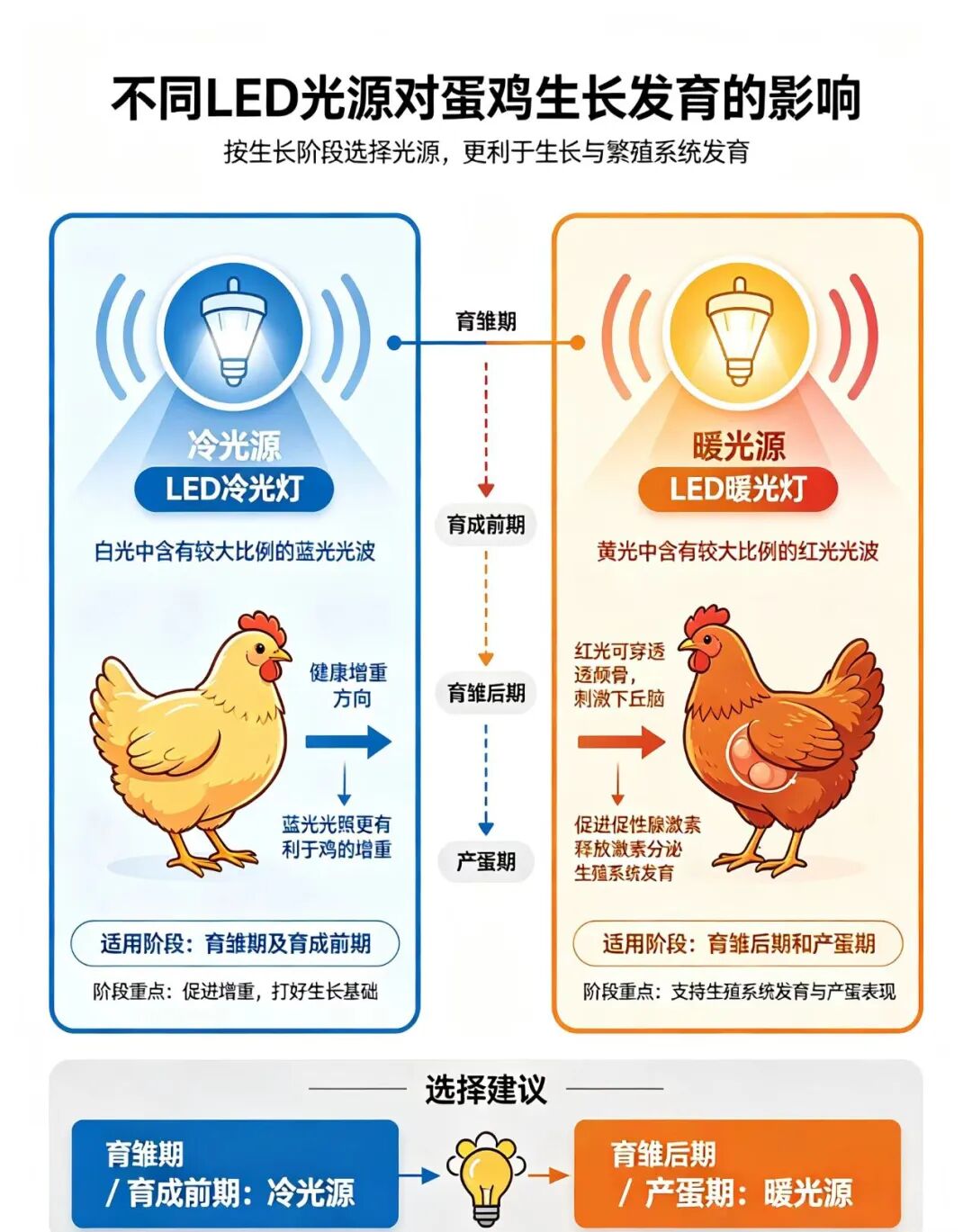
Misconception seven: The supplemental lighting schedule is unreasonable
Manifestation: Supplemental lighting is provided only during the day, or continuously for an extended period at night, disregarding the chickens’ physiological rhythms.
Hazards: Supplemental lighting during a single time period can disrupt chickens’ routines; suddenly turning on bright lights at night can easily startle the flock and cause it to panic; and it affects the balanced distribution of feeding, drinking, and resting.
Response measures:
Recommended supplemental lighting in separate morning and evening sessions: morning lighting helps the flock start eating earlier, while evening lighting extends feeding time; simulate changes in natural light to achieve a “gradually brightening—steady brightness—gradually dimming” transition; avoid suddenly turning on the lights late at night.
Misconception eight: Overlooking the synergy between lighting and other environmental factors
Manifestation: focusing only on lighting while ignoring supporting management of temperature, ventilation, humidity, and other factors.
Hazards: Lighting stimulates egg production, but if environmental conditions are poor (such as low temperatures, high humidity, or high ammonia levels), egg production will still decline; the combination of lighting and cold stress can easily trigger respiratory diseases or salpingitis.
Countermeasures:
Lighting management should be carried out in conjunction with insulation, ventilation, and dust removal. In late autumn, pay attention to insulation at night; close the side windows when providing supplemental lighting to reduce fan operation. Increase ventilation during hot periods of the day and, if necessary, spray water to reduce dust.
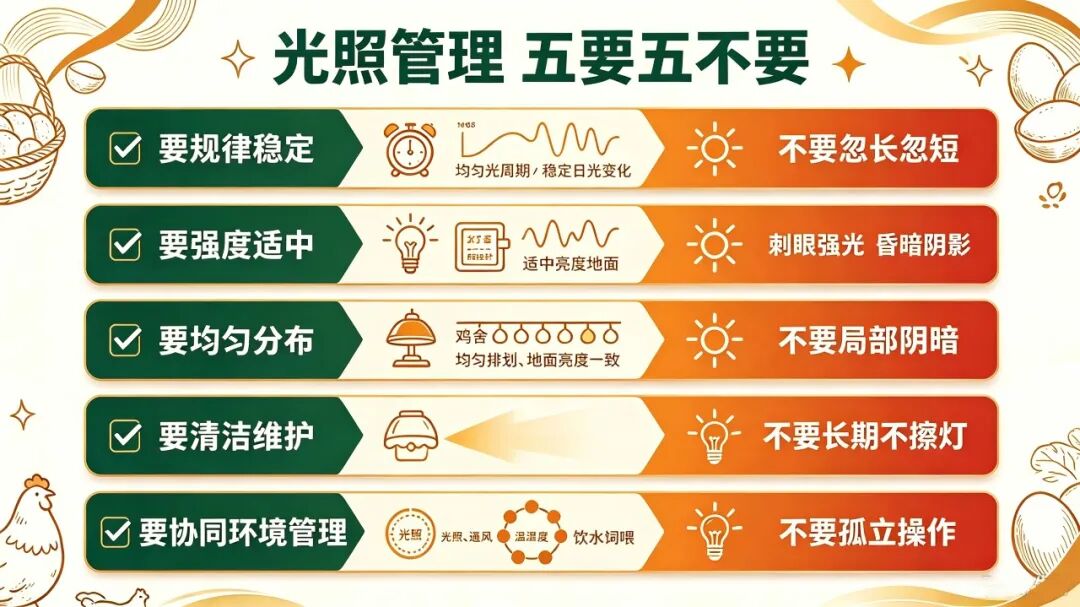
Closing remarks
Light management may seem simple, but it is actually a precise process. Avoiding the pitfalls above and adhering to the principles of “scientific, stable, and coordinated” management are essential to truly harnessing the benefits of lighting for laying hen performance. It is recommended that poultry farmers provide regular training, establish standardized operating procedures, and make dynamic adjustments based on production data to achieve efficient, healthy, and sustainable layer farming.
Source: Shanghai Fulangte, author: Cheng Yunjie
Welcome to the Poultry Disease Professional Network forum to learn and exchange ideas!
Welcome to submit a quote at the quotation center!
Official WeChat account of the Chicken Disease Professional Network for collecting information on laying hens: 15237170695. The mobile phone number is the same. We welcome you to provide us with information!
Stay fully up to date on daily egg prices by following just one official account.
You can scan the QR code.