
Ruminant heat stress, silage quality and the importance of clever feed strategies
From Paris, Texas, to Paris, France, summer 2026 brought periods of exceptional heat to major cattle-producing regions on both sides of the Atlantic. By early August, nearly half of the USA was in an official state of drought. Similarly, record-breaking conditions were seen across much of Western Europe. This pattern of increasingly warm weather has significant consequences that extend well beyond the immediate effects of heat on animals.
On the one hand, heat stress in cattle is estimated to cause global losses of more than US$10 billion each year. Rising temperatures can also compromise the availability and quality of crops for silage production. Together, these pressures challenge the industry: warmer weather reduces herd performance and silage quality, increasing waste and resource use, undermining sustainability targets and, ultimately, contributing to an increasingly volatile climate.
No single intervention can break this cycle because, as farmers know, real change requires action across the entire cattle production system. That being said, there are steps that farms can implement to improve their livestock’s resilience to extreme weather, namely smart feed management. By supporting rumen function during heat stress, preserving silage quality and increasing output from every tonne fed, targeted microbial strategies can help improve resource efficiency and reduce emission intensity as part of a wider farm sustainability strategy.
Nutrition as a key mitigation lever
As the mercury rises higher each summer, so does the incidence of heat stress in cattle. When the Temperature-Humidity Index (THI) exceeds 68 to 70, animals can no longer effectively dissipate body heat, leading to reduced dry matter intake (DMI) and lower rumination, which negatively affects the composition and efficiency of the rumen microbiota. This diminished digestive capacity means lower milk and meat yields for the same amount of feed, undermining farmers’ efforts to improve resource efficiency and reduce methane intensity.
Beyond essential heat-abatement steps (shade, cooling, and plentiful cool, clean water), one of the most effective strategies farmers can use to support environmental efficiency in heat-stressed cattle is adding live yeast Saccharomyces cerevisiae CNCM I‑1077 (Levucell SC) to their daily feed. This rumen‑specific strain has been shown to enhance animal comfort by improving rumen pH while also improving fibre degradation when paired with a sufficient supply of physically effective fibre (peNDF). In a meta-analysis of 15 beef cattle studies, it was demonstrated that supplementation with Saccharomyces cerevisiae CNCM I‑1077 consistently improved average daily gain by 7% and feed conversion ratio by 3% under a wide range of production conditions – but these benefits appear even more pronounced during periods of elevated stress, such as in hot weather. For example, in a recent commercial‑scale feedlot trial conducted during the hot Californian summer, 1,073 Holstein steers entered their 100–day finishing period during sustained heat stress (including 50 days with THI >75 for 24 h) on a ration with 9.3% peNDF.
Figure 1 - Saccharomyces cerevisiae CNCM I-1077 (Levucell SC)-fed cattle numerically improved ADG by 4.6% (0.930 vs 0.889 kg/d).
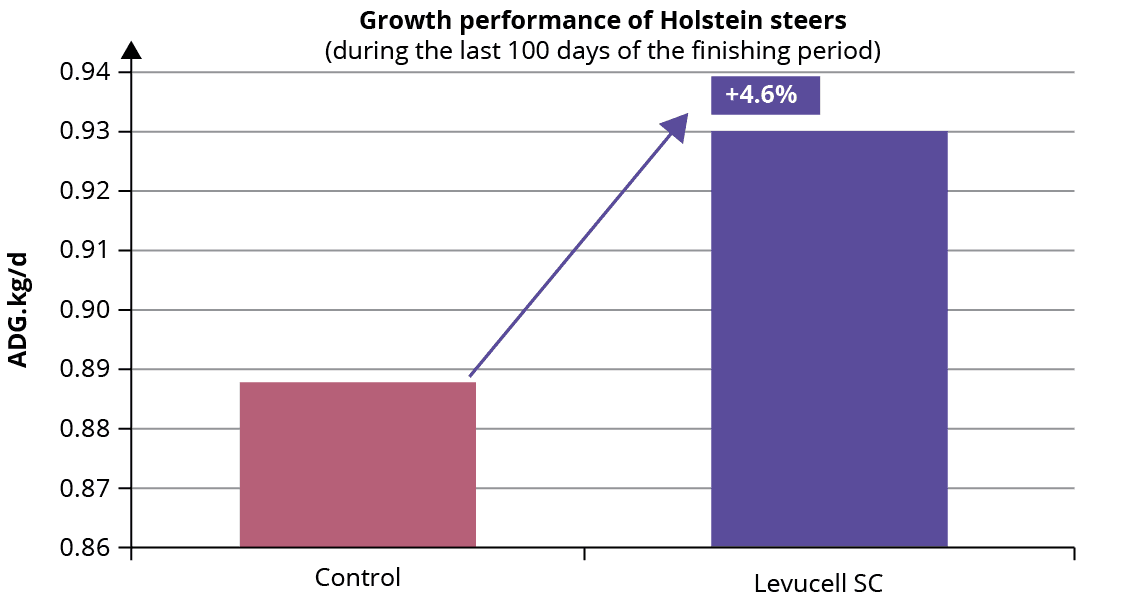
Cattle supplemented with Saccharomyces cerevisiae CNCM I‑1077 showed higher performance versus the control, with a 4.6% higher average daily weight gain (Figure 1) and 10.5% better feed conversion ratio. Despite lower feed intake under heat-stress conditions, the supplement group also reached finishing weight eight days sooner while maintaining carcass quality.
Similarly supportive results were obtained when dairy cows experiencing heat stress (THI ≈ 80) were supplemented with Saccharomyces cerevisiae CNCM I-1077. As demonstrated by a controlled University of Florida study, animals in the supplement group showed a 7.6% gain in feed efficiency (+130 g milk per kg DMI), which resulted in a 6.1% lower carbon footprint per kg fat- and protein-corrected milk according to a later ISO-conformant life cycle assessment (LCA) (Figure 2).
Figure 2 - Effect of Saccharomyces cerevisiae CNCM 1-1077 (Levucell SC) supplementation on 7 PEFCR
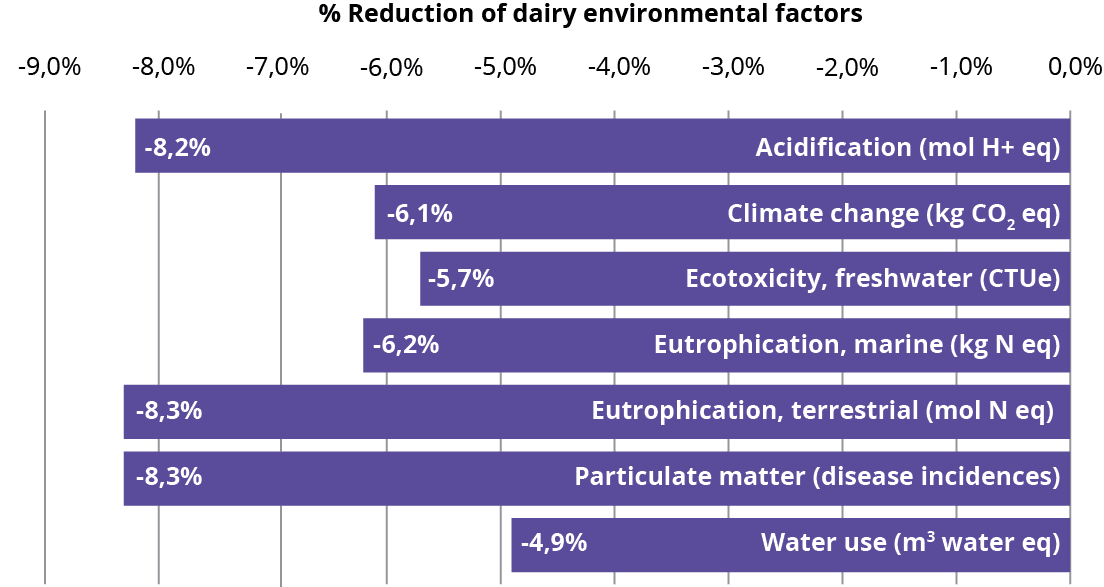
As these studies show, improving rumen efficiency can enhance feed utilisation, helping livestock farmers improve productivity and reduce the environmental footprint per unit of milk.
The foundations of sustainable farming
Continuing the theme of efficiency for both environmental and economic benefit, a huge amount of a farm’s profitability rests on the quality of the silage in its bunkers. Even the most advanced nutritional supplements can’t make up for poor-quality silage, and we’ve seen how a sufficient supply of peNDF is needed to get the most value from live yeast feed additives.
As with the cattle themselves, however, rising global temperatures are severely affecting forage crops. Indeed, an average global temperature increase of just 1°C is estimated to reduce yields by 5–10%. As growing conditions and crop availability become more unpredictable, farmers need actionable strategies to maximise the output of every bunker, bag, or bale of silage. Enter bacteria- and enzyme-based forage inoculants.
By accelerating lactic fermentation and limiting heating, inoculants help retain dry matter volume, preserve more essential nutrients and boost feed performance. One six-week feed trial found that the addition of a specific forage inoculant (Magniva Platinum 3) to the ration of lactating Holstein cows increased their DMI by 0.92 kg, allowing them to produce 2.2 kg more energy-corrected milk (ECM) per day compared with cows fed untreated silage. With a higher milk yield from a similar level of methane emissions, cows in the treated group achieved a 4.1% lower methane intensity, demonstrating the environmental value of forage inoculants.
Some challenge-specific inoculant formulations also include enzymes that improve fibre digestibility, allowing cattle to extract more energy from the same amount and type of forage. The practical outcome is better feed efficiency. With more milk or beef per tonne fed, farms can meet production targets with less land, water and bought‑in feed used, and less silage effluent produced in the process. While the journey towards more sustainable cattle production will require coordination across multiple areas, integrating specialised forage inoculants is one surprisingly simple step that can preserve silage quality, improve resource efficiency, and strengthen farm resilience.
Microorganisms with macro impact
No single solution exists for the climate-related challenges facing livestock farms, and adapting to their effects cannot replace action to address their causes. But as the strategies discussed in this article show, applying specialised yeast or bacterial strains can help animals’ digestive systems adapt to a warming climate, boost farm productivity and profitability, and even lower carbon intensity. When used alongside improvements in animal health, nutrition, resource use, and farm management, they can support a more resilient and responsible approach to livestock production.
References available upon request