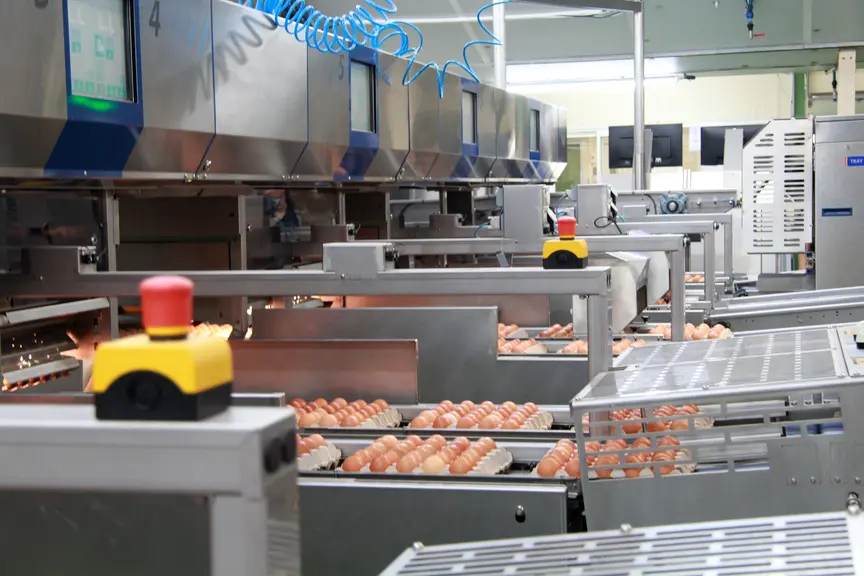
According to estimates, achieving self-sufficiency in eggs in 2035 will mean meeting demand of 269 eggs (including 188 shell eggs and 81 in egg products) per year per inhabitant in less than 10 years.
Read also: Nearly 600 laying-hen buildings to be built by 2035
This is while the French market is exposed to the growing arrival of imported eggs from caged hens (+23% in the 1st half of the year), notably from Ukraine and Turkey, where costs are lower than those of eggs produced in France under different quality standards.
Such an increase in production would require 10 million new places for laying hens over 10 years, or around 575 poultry houses. At the same time, the transition to cage-free farming is expected to continue; the target set is for 90% of laying hens to be cage-free by 2030. This target requires efforts on the part of farmers, since the proportion of laying hens in alternative farming systems stood at 78% on July 1st, 2026, distributed as follows: 34% free-range, 25% barn-raised, 14% organic and 5% Label Rouge*.
Alice Richard, Director of the CNPO, was keen to point out that in France 51% of hens have access to the outdoors, a distinctive feature within the European Union, where 23% of hens have this privilege. The CNPO also aims to increase the presence of the “Oeufs de France” logo on cartons and egg products, as well as on prepared products and in food service.
Stay up to date in real time!
Follow topics, legislative projects, companies, and public figures to be notified as soon as we publish an article.
Visits to the egg sector in Auvergne-Rhône-Alpes
To illustrate the changes made by stakeholders in the sector, the group of journalists took a trip to Auvergne-Rhône-Alpes, first visiting Drôme. The visitors continued their route to Isère, where Mickaël Albertin has just inaugurated his building to house 30 000 laying hens kept on the floor. This activity complements walnut and potato production. This farm has a contract with Fermiers du Sud-Est.
Next stop: France’s oldest miller and pasta maker, Alpina Savoie. This Living Heritage Company and its 170 employees process durum wheat, and eggs from French free-range farms are among those used to make crozets.
Finally, the visit ended in Isère with Sébastien and Christophe Candy, who added a unit for 6 000 Label Rouge laying hens to their farm, on a wooded plot of 3 hectares. They benefited from a livestock relocation program, an initiative aimed at producing and marketing locally.
* ITAVI source.